Wednesday, May 9, 2012

Born-again biker

Satisfied customer!
Here's a story about how bike-sharing is a terrific enhancement of public transport -- one that works for all kinds of people. I have a friend, Charlie Szabo, who was born and raised in Budapest, but now lives in Washington D.C. His main mode of local transport -- in Budapest and in D.C. -- has always been public transport.

However, in recent years he's been frustrated with the standard of D.C.'s system. It has no trams (although there's a plan afoot to reintroduce them) and the metro system is often broken down, unreliable or worse. Charlie says the escalators hardly ever work, which made me think of the escalator at the Margit hid HEV stop, but Charlie assures me it's a more pervasive, chronic problem there.

Charlie's deliverance from sub-par mass transit came in the form of a bike-sharing service. D.C. first launched bike sharing on an experimental basis back in 2008 with a token fleet of 120 bikes and 10 docking points. Despite the limited utility of the system, thousands of people jumped on board. Emboldened by the positive response, the neighbouring jurisdictions of Washington DC and Arlington, Virginia jointly launched a full-scale public bike system in 2010 called Capital Bikeshare ("CaBi" for short). The system now has 1,200 bikes and 140 stations around the metro area.

Until recently, Charlie has not been super active and he admitted to me that, aside from a pedal-powered beer run last summer at  Balaton, he had not ridden a bicycle in more than 20 years. But Capital Bikeshare proved too good to pass up. He lives pretty close to the centre of things and says the service is very convenient for his transport needs. Here's what he told me about it:
Happy to report that i just signed up for capitalbikeshare, and loving it!! It's been around for about a year, and new bike racks are popping up in DC and Arlington and Pentagon City just about every couple weeks. It costs $ 75 for a year and the first 30 minutes is free, but you get another 30 if you plug it in and take it out again. It really cuts down on bus fare and saves a lot of time and i might even get in shape for bikini season, too!! 
This is the most encouraging endorsement I've ever seen on bike sharing. Awesome!

Monday, April 23, 2012

April showers, pedal power

Beware the Green Shirts, courtesy of http://indafoto.hu/szentpeter/criticalmass_2012
The traditional Earth Day Critical Mass went off yesterday with a good result, considering the cool, sometimes rainy weather. An estimated 10,000 participants joined the procession, which ran approximately 10 km from Szent Istvan Park to Varosliget.

Last year's shirt says she's a CM veteran, courtesy of http://indafoto.hu/szentpeter/criticalmass_2012
Critical Honcho Gabor Kurti commented on recent evidence that the number of everyday cyclists in the city is growing rapidly. In March, the first year-on-year results were posted from the automatic cyclist counter on the kiskorut in front of the National Museum. It seems the number of passing cyclists this March was 80 percent greater than last March.

"That many everyday cyclists is going to completely change the face of the city," Kurti told Nepszava.hu.

As with the past several iterations of the twice-annual ride, the Dutch Embassy was a sponsor and held an after-party at the Toldi Cinema, where the movie, Rikshaw Rush ('Riksa Laz') was screened. Appropriately combining the key elements of Hungary, Netherlands and bicycling, this movie tells the story of Hungarian Rickshaw Taxi drivers in Amsterdam (believe it or not).

Recumbent magyar patriots, courtesy of http://indafoto.hu/szentpeter/criticalmass_2012
Sorry to say, I can't add any personal observations. I was on a family trip in the Styrian countryside, and did it by car which is practically Earth Day sacrilege. Whatever I do next year, I'll try to do it by bike.

Friday, March 2, 2012

Bubi Seeks Supplier


The sharp logo for Bubi
is a good start.

Work continues on Budapest's future bike-share system, christened "Bubi" according to a popular vote in the fall of 2010. Later this month, the search will begin for a system supplier -- a commercial enterprise that could provide bikes, docking stations, payment system and other technology and services that would make it go.

To this end, the city-owned company in charge of Bubi, the Budapest Transport Center (BKK -- Budapest Közlekedési Központ), has scheduled an "information day" on March 21 where would-be suppliers can present their goods. The event isn't public -- just interested contractors are invited.

The programme's agenda is here and those who have further questions are asked to contact Gergely Kovács and Péter Dalos of the engineering firm COWI Hungary Ltd., the subcontractor that did Bubi's feasibility study and other groundwork. Their email: kerekpar@cowi.hu.

Luckily for Budapest, public bicycle systems have quite some history by now, and BKK should have a good choice of suppliers: firms such as JCDecaux, Clear Channel and Next Bike have implemented and operate hundreds of similar systems throughout Europe and beyond.

But due to a peculiarity of Budapest's situation, Bubi's financial set-up could be tricky. The vast majority of the implementation costs will be funded by an EU subsidy (HUF 900 million or EUR 3.1 million), and this will apparently put certain constraints on how BKK finances the operating costs. Many other systems around the world partner with a big commercial sponsor (e.g. Barclay's Bike Hire in London) or an ad company (e.g. JCDecaux and Clear Channel). These arrangements lessen the burden on the municipal budget -- or at least create the illusion of doing so. However, due to the Bubi's big EU subsidy, such models may not be legally possible in Budapest.

Hopefully some clever ideas come up at this month's meeting, and the long-term prospects for Bubi will be more clear.

Thursday, February 9, 2012

Stitching Together a Cycling Culture

With Budapest and the rest of Europe in the clutch of a cycling-averse cold snap, the only bike news I'm anticipating in the coming weeks is the prospect that we may soon be able to pedal across the surface of the Danube. In the meantime, I wanted to post this feature about the budding local industry in Budapest focused on cycling accessories and cycling fashion. It seems to me a rare example of capitalism going hand-in-hand with progressive social activism rather than merely exploiting it (apologies to fans of CSR).

Tamás Tűhegyi sewing bags as his mother taught him.
In Budapest, a cottage industry of cycling fashion and accessories has blossomed in recent years, one of the fruits of the local cycling and Critical Mass movement. It includes makers of clothing, accessories and small-production boutique bicycles. Not only has it given sustenance to those directly involved, it has helped drive an emerging DIY movement concerned with sustainable, local production; “buy-local” shopping and, of course, environmentally friendly mobility.
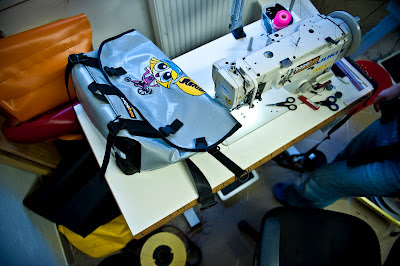
With each of its bags being handmade, Bagaboo can offer custom detailing.
The small bike-bag maker Bagaboo typifies the movement. The company started in 2006, a classic case of necessity as the mother of invention. Local bicycle courier Tamás Tűhegyi, then 25 and working for an outfit called Herce-Hurca (roughly, 'Much ado about nothing'), needed a new parcel bag, but the only manufacturer in Hungary was notoriously slow in filling orders. So Tűhegyi decided to make one himself on a home sewing machine. With the help of his mother, an accomplished seamstress, he produced a bag and the idea of a commercial enterprise was born.


Tűhegyi worked on design and manufacturing, his mother helped with custom embroidery and his sister pitched in by answering email orders and processing invoices. From the beginning, Bagaboo strived to fill a niche for durable, customizable bags that match the quality of established international brands while having the cost advantages of a Central European base. Initially, the company plied the Hungarian market, advertising on the Internet and through Tűhegyi’s social connections in the bike-messenger community. In time, he translated the website into English and began selling bags abroad, mainly in Japan, Germany and the UK, and recently in the Netherlands.


The company's product line began with a basic messenger bag and hip pouch, and was soon beefed up with a professional messenger bag called the "Workhorse". These days, the selection also incorporates double-strapped backpacks, tool pouches, iPad sleeves and U-lock cases. As evidence of Bagaboo's fashion focus, the website describes an item called the "Eco-bag" as ideal for customers "who like the style ... of messenger bags, but not always using their bag on a bicycle". Future bags will be designed especially for school children. (As I told Tűhegyi, considering the volume of stuff Hungarian school kids have to schlep back and forth from school, this is sure to be a lucrative market).

When I did an email interview with him last week, Tűhegyi said he didn't know how many bags he produced per month. He said he's only concerned whether the business is running smoothly, and that he doesn't keep track of things like production volume or growth forecasts. However, in a 2008 article, he indicated that the company was making approximately 100 bags per month at that time, with each of Bagaboo's five sewers turning out approximately one bag every three hours. These days, in addition to founding family members, Bagaboo employs six workers to cut fabric and sew bags, and production has moved from the family flat to a proper industrial space.

Although its markets have expanded beyond Hungary's borders, Bagaboo maintains a highly visible presence in the Budapest cycling community. Along with fellow Hungarian bag makers such as Bring a Bag and Lupusbag, Bagaboo highlights its products regularly at bicycle fashion shows in the capital city. A staple of the cycling community’s social calendar, these events provide a stage where traders of cycling paraphernalia can show off their wares in an entertaining, social atmosphere. Bike fashion shows have been held as side events for the twice annual Critical Mass and during closing parties for the national bike-to-work contest (Bringazz a munkaba). Always including participation of cycling activist groups, the events seem to be a simpatico blend of social activism and commerce.

Alongside other local businesses, Bagaboo partners with the Hungarian Cyclists Club, having an icon on the organisation’s homepage and an ongoing promotion in which club members can buy the company's products at a discount.

Despite evidence to the contrary, though, Tűhegyi gives a modest assessment of the industry’s role in popularising urban cycling. Having volunteered as an escort for one of Budapest’s first Critical Masses in the mid-aughts, Tűhegyi still believes that this highly popular social movement is the main driver of the local urban cycling movement. Other actors in the community, including Bagaboo, contribute relatively minor roles, he said.

I asked Janos Laszlo, president of the Hungarian Cyclists Club, about the contribution that companies like Bagaboo make to the popularising of everyday cycling. I was a little disappointed that he didn't give me the expected, agreeable quote that would neatly affirm my thesis. Instead he expressed a viewpoint that I'm familiar with from the CycleChic blog: that people shouldn't feel they need to have special equipment, clothing and accessories in order to cycle.

I agree with that. However, considering the success of dozens of cycle fashion shows over the years, not to mention the proliferation of fixi bikes, rolled-up pant cuffs and messenger (or pseudo-messenger) bags on Budapest streets, there's no question that these trends are part and parcel of the recent upsurge in everyday cycling in Budapest. So while I believe that vanity and consumerism underlie many of society's problems, I'm going to give a pass to cycling fashion.

Tuesday, January 31, 2012

Car Tax Dead but Congestion Charge Gets a Lift

A proposal to levy a flat monthly tax on Budapest car owners looked dead on arrival today. Budapest City Hall, grasping for a life line to pull BKV out of its financial quagmire, was considering a monthly tax of almost HUF 10,000 a month on car owners, which would raise an estimated HUF 32 billion per year. But the idea lasted about half a news cycle. Mayor Istvan Tarlos and just about everyone else denied having anything to do with introducing the proposal, and by Wednesday afternoon, the mayor was saying it was stillborn.

The encouraging news is that the idea of a congestion charge is still alive. Antal Rogan, mayor of District V and leader of the Fidesz faction in the City Assembly, pronouced that this would be would be a "more rational and reasonable solution."

I am in complete agreement. The reason a congestion charge would be better is because it would be levied only on drivers entering downtown. Car owners who don't come downtown or who come by another mode (public transport, foot, boat or bike) don't have to pay.

With congestion charges, the intent is to put a price on road use and thereby pressure some car owners to not drive downtown. The avoided traffic leads to reduced congestion, while the remaining traffic yields revenue that can be used to improve non-car mobility options (public transport, bike lanes and foot paths), which will lead to further reduction in car use. A virtuous cycle.

Congestion charges are very controversial because you're asking people to pay something that they currently get for free. However, the free-of-charge status quo does come with a price: travelers' time. It is partly because road use is free that they're so crowded. Putting a price on them will mean that those who don't really need to drive downtown will avoid the trip while those who do need to will be able to make the journey on less congested streets. This perspective prompted a New Zealand blogger to say that congestion charging should really be sold as a "congestion avoidance" scheme.

Some conservative bloggers have argued -- a bit disingenuously -- that such charges are unfair because they tax the poor so the rich can drive fast. But roadways are a valuable, limited resource and there's no reason why they should be free of charge to everyone at all times. And, in any case, a congestion charge can be implemented to include consideration for social fairness, including income-based discounts.

I imagine the flat, monthly tax seemed an attractive option to decision makers because it would be relatively simple and inexpensive to implement. A congestion charging scheme, by contrast, will involve a cordon of ANPR cameras that monitor every entry point into downtown along with enabling legislation at the national level and more. However, there's no sense in taxing every car owner regardless of their travel habits. I hope the city leadership can use the opportunity of the current crisis to push forward a sensible idea.


Friday, January 20, 2012

Courting the Cyclists

As part of my continuing series of occasional posts about how hip cyclists are, I offer this link about a hipster-targetted concert Saturday night by the Budapest Festival Orchestra.

Unusually for a BFO concert, this event is starting at 11:30 p.m. and is staged not in the hoity-toity Palace of Arts on Soroksari ut but at a venue that normally hosts shows by pop and folk bands and rock stars from the dark and distant past.

Also unusually for a BFO concert, the playbill features a picture of someone wearing a sleeveless denim vest, over-ear headphones and a big furry wolf's head. This plus the bold, paint-brush font for the lettering tells you straight away that the event is not targeted at the usual conservative crowd.

The cycling angle comes from a post on the Hungarian Cyclists Club website, where BFO Conductor Iván Fischer makes a direct invitation to the hipster elite. Fischer made his last splash in the cycling world in the fall, when he conducted a free concert at Heroes' Square on the occasion of the European Car-Free Day Critical Mass. 

Now he's doing another concert just for cyclists -- apparently he really loves us. Either that, or he wants people to believe he really loves us, which, of course, is only natural. Fischer writes this on the cycling club's site:

Dear Budapest cyclists,
When at Heroes' Square, I saw the raised bicycles and thought, it would be nice to hold a concert just for young people, late at night, when older people are asleep, and when, for a few minutes, there aren't so many cars on the streets, and it's possible to bike to the concert hall. Now it's a reality -- for you - on the night of Jan. 21 at the Millenáris Teatrum. Come one and all to Midnight Music. Tickets will be very cheap, only for a small contribution to the costs.
The tickets are extremely cheap by BFO standards -- just HUF 1,200. And if you belong the cyclists' club or come by bike, you get a further 30 percent discount.

So, along with the concessionaires at Liszt Ferenc Airport and the fabric store at Jaszai Mari ter, Iván Fischer joins the queue of Hungarian opinion leaders who are desperately trying to ingratiate themselves with cyclists just because we're so cool.

Good luck to you, maestro.

Tuesday, January 17, 2012

Crash Prevention Efforts Out of Focus

Although police have determined that car drivers caused more than five times as many crashes as cyclists last year, authorities intend to make "two-wheelers" the focus of accident prevention measures.

That's the counter-intuitive conclusion of the National Accident Prevention Committee (Országos Baleset-megelőzési Bizottság) in light of year-end road-crash data published this week in the Metropol newsaper.

The overall numbers are encouraging, showing that injurious or fatal road crashes in 2011 were down year on year from 16,308 to 15,800 -- a 3.1 percent drop. Fatal injuries were down from 649 to 571, or 12 percent.

Looking at the causes of accidents, Zsolt Halmos, vice-president of the committee (a body of the national police force), had this remarkable thing to say:
 "The National Accident Prevention Committee this year plans to put two-wheelers in the spotlight since last year's statistics show that while those who caused the accidents were predominantly drivers (61 percent), the second-ranking category was cyclists (12 percent)." 
Maybe I'm missing something, but why would the number-two category of offenders be the number-one target of enforcement efforts?

Halmos explained that there's a "misconception" that accidents caused by cyclists are harmful to cyclists only. On the contrary, he said, it's very often the case that a cyclist turns unexpectedly into the path of a car, causing the driver to steer into the opposite lane and get into a head-on collision.

I don't dispute that this sometimes happens. What's left unexamined is that such mishaps end disastrously because the others involved are in cars. 


Sure, there are freak instances when a serious injury or even death results from a cyclist-cyclist or cyclist pedestrian accident. But I would wager that more than 99 percent of road fatalities involve one or more cars. Death and injury in collisions depend on an excess of kinetic energy -- 1/2 mass times velocity squared -- and this is the magic ingredient that motor vehicles bring to road crashes.


That  being the case, why aren't cars in the committee's "spotlight"?