Showing posts with label public transport. Show all posts

Wednesday, February 17, 2016

Chrissie Hynde: Walker and Rocker


It's cool when your heroes do you proud. Often, the opposite happens (Lance Armstrong was a major disappointment), but over the past few years some of my favourite musicians from punk-rock days have turned out to be cool in ways I hadn't expected. For instance, my favourite bass player of all time, Mike Watt (Minutemen and fIREHOSE), became a born-again cyclist at age 37 after a 22-year hiatus of going by car only ("I  was an asshole!" he's quoted as saying). Then Talking Heads frontman David Byrne did Watt one better by becoming a spokesman for active transport and public space reform in New York City, and then writing a book about the joys of cycling. Recently, it's happened again: Chrissie Hynde, singer and rhythm guitarist for the (great) Pretenders, stunned and amazed me in a recent autobiography when she laid down some biting social commentary about the value of public transport and how her home country shot itself in the foot by killing it off.

Ok, "stunned and amazed" is exaggeration. Hynde has said some of this before. One of the Pretender's biggest hits, My City Was Gone, told of Hynde's dismay at what had become of her hometown, Akron, Ohio, in the wake of Autogeddon: the disappearance of the train station and of downtown, and the paving over of the surrounding countryside with shopping mall parking lots.

Her new book (actually published at the end of 2015) expands on these observations and shows that sustainable transport (not a term she uses -- but this is what she's taking about) is a huge preoccupation. In fact, after reading the book, it's a fair bet that sustainable transport (America's lack of it vs. Europe's wealth) is the main reason Hynde abandoned the States in her 20s, before she'd even made a name for herself, and then settled in London, where she hit the big time and still resides at age 65.

In an early chapter, Hynde describes the Akron of her childhood ('50s, early '60s),  as America's slide into car-centrism was under way. Hynde and a friend from junior high found themselves outcasts because they walked.
"Neither of us was interested in what the 'popular' kids were interested in ... . But what really set us apart, aside from our love of sewing, was that we were walkers. Our favorite pastime was walking to downtown Akron ... We walked, rambling and philosophizing; our journeys up West Market Street were adventures. We studied every house and redbrick road, speculating about their histories while discussing the world and what might be out there beyond Akron ... ."
One day, Hynde got on a bus for a covert excursion.
"Taking a bus almost felt like a subversive act, given that most (white) Americans living in the suburbs were required to have at least one car per family. Only 'poor people' got buses in the new world. Well, you couldn't walk to a bus stop out there -- it was too far. You'd have to get a lift to catch the bus, so why bother taking the bus if you were driving anyway?"
In her 20s, Hynde finally did get out of Ohio, and her peregrinations eventually led to London. She loved the Victorian buildings, cobbled streets and double decker buses. But the big revelation was the ease of getting around:
"Public transport! (What genius thought that one up? If the word got out in America, they'd all want it!) I could now go wherever I wanted, whenever I wanted. The days of waiting for someone to pick me up in a car were over. For the first time I felt like my own person; I didn't have to answer to anyone. It felt so right, like something I'd been waiting all my life for."
Of course, most of the book is about Hynde's music career, but I recommend it also for her social commentary on the differences between the US and Britain, including quite a bit about transport. For me, a fellow transport exile who loves the trams, buses and trains of Europe, this book showed a little of the heart behind Hynde's trademark snarl.

Wednesday, May 9, 2012

Born-again biker

Satisfied customer!
Here's a story about how bike-sharing is a terrific enhancement of public transport -- one that works for all kinds of people. I have a friend, Charlie Szabo, who was born and raised in Budapest, but now lives in Washington D.C. His main mode of local transport -- in Budapest and in D.C. -- has always been public transport.

However, in recent years he's been frustrated with the standard of D.C.'s system. It has no trams (although there's a plan afoot to reintroduce them) and the metro system is often broken down, unreliable or worse. Charlie says the escalators hardly ever work, which made me think of the escalator at the Margit hid HEV stop, but Charlie assures me it's a more pervasive, chronic problem there.

Charlie's deliverance from sub-par mass transit came in the form of a bike-sharing service. D.C. first launched bike sharing on an experimental basis back in 2008 with a token fleet of 120 bikes and 10 docking points. Despite the limited utility of the system, thousands of people jumped on board. Emboldened by the positive response, the neighbouring jurisdictions of Washington DC and Arlington, Virginia jointly launched a full-scale public bike system in 2010 called Capital Bikeshare ("CaBi" for short). The system now has 1,200 bikes and 140 stations around the metro area.

Until recently, Charlie has not been super active and he admitted to me that, aside from a pedal-powered beer run last summer at  Balaton, he had not ridden a bicycle in more than 20 years. But Capital Bikeshare proved too good to pass up. He lives pretty close to the centre of things and says the service is very convenient for his transport needs. Here's what he told me about it:
Happy to report that i just signed up for capitalbikeshare, and loving it!! It's been around for about a year, and new bike racks are popping up in DC and Arlington and Pentagon City just about every couple weeks. It costs $ 75 for a year and the first 30 minutes is free, but you get another 30 if you plug it in and take it out again. It really cuts down on bus fare and saves a lot of time and i might even get in shape for bikini season, too!! 
This is the most encouraging endorsement I've ever seen on bike sharing. Awesome!

Sunday, March 7, 2010

Car-free holiday -- almost

For the past several winters, we've gone on family ski vacations somewhere in Italy or Austria and this has always been one of the rare weeks out of the year where we abandon our car-free ideals for the sake of speed and convenience. This year, however, we went some way toward rectifying the situation.

In Europe, it's actually quite possible to do a car-free ski trip. There are train and/or long-distance bus connections to virually all resorts and everywhere I've skied, I've always noticed local buses ferrying skiers up and down the mountain. However, at large ski areas, it's often the case that the only affordable accommodations are quite removed from the main roads. And while a half-kilometre walk to a bus stop wouldn't put me off in normal circumstances, it seems like a slog when I'm freighted down with gear and hobbling in ski boots.

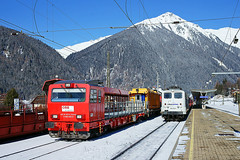
This year, though, we went to a smallish resort in Carinthia a couple hundred kilometres south of Salzburg called Mallnitz. We found a decent, affordable pension in the middle of the village that was within a 5-10 minute walk of everything we needed: grocery store, restaurants, ski shop and even a swimming complex with sauna and jacuzzi. A free-of-charge ski bus left every 20 minutes in mornings and afternoons, offering a 10-minute connection to the closest alpine slopes. For those of us on a cross-country regimen, a nicely groomed circuit lied less than five minutes from our rooms in the village.

Our friends who drove us to Mallnitz from Budapest managed to go the whole week without using their car. Among other things, this meant they could have some wine or beer with lunch without worrying about European zero-tolerance drunk driving rules. But probably the nicest thing about Mallnitz was just being in the kind of place where a car is absolutely unnecessary -- a village that you can negotiate by sidewalk, checking out restaurant menus, shop windows and sale prices until something caught your eye.

As it turned out, we hadn't even needed the car to get to Mallnitz. We'd investigated rail options before our holiday, but made the mistake of consulting only the site for the Hungarian Rail Company, MÁV: there we could find only some really difficult connections. As we learned after our arrival in Mallnitz, there is more comprehensive information on the portal for the Austrian rail servoce, ÖBB. This shows daily trips in both directions lasting about eight hours -- almost on par with the car trip if you include rest and meal stops.

So as an experiment, my 5-year-old boy and I took the train for the return trip to Budpest. The train from Mallnitz to Salzburg was completely packed with vacationers, and became more so as we stopped at one ski resort after another up the Gastein Valley. We had an hour stop in Salzburg, and then boarded a brand-new, high-speed Austrian train called the Railjet. This is a fantastic way to travel, comfortable, quiet and clean ... and cruising along at 200 kph (127 mph) on countryside stretches. Aside from the aforementioned advantage of being able to drink -- an essential ingredient to any vacation in my opinion -- the Railjet also included a little "kinderkorner" with a TV showing and endless loop of Disney cartoons. The whole trip from Mallnitz to Budapest wast just EUR 60, including the free-of-charge ticket for my boy.

It seems the longer I go without regularly using cars, the less I like them -- the tight space, the lack of air, the fact you're moving so fast with nothing but flimsy metal panels and tempered glass between you and disaster. This last trip opened my eyes to an excellent holiday option that doesn't require a car. We were so psyched about the trip that we're already planning a return in summer -- and this time bringing our bikes.