Monday, April 12, 2010

London's New Wave


During the past few years, I'd heard a lot about the burgeoning cycling scene in London: the Tube commuters with their folding bikes and the black-clad cycling ninjas riding fender to fender with racing Black Cabs. The derogatory tone of these accounts suggested London cyclists were a small group of half-mad outliers who'd probably be crushed under the wheels of a double-decker bus before they got the chance to breed.

However, when I visited the city last week, I saw that the cycling scene is alive and well. The cyclists there are indeed a group of half-mad outliers. But they're not a small group. During rush hour, they seem to be everywhere, sometimes queuing up at stoplights several cyclists deep. The cycling thing is really catching on in London. I heard estimates of a 5% modal share in the city centre, and with levels comparable to Copenhagen's in the borough of Hyde Park (I took the Tube there to verify this and did not see many cyclists, but my visit was 2-3 hours before evening rush hour on a rainy day.)

London cyclists, like Londoners in general, seem desperately competitive, but with unfailing self-discipline. There are hardly any separated paths in London; most of the cycling network consists of painted lanes, and the cyclists who use them ride fast and warrily amid constant heavy traffic. The cyclists generally wear gear -- shorts almost always, a bright fluorescent rain slicker when it's raining (i.e. almost always), and usually a helmet. Although they ride fast, they are scrupulous about doing proper hand signals and, at least in comparison to most places I've bicycled, they tend to abide by road rules.


As in Budapest, there's this John Henry-like propensity among street cyclists to test man against machine, and there is a large number of hard men on fixies. However, the London fixie crowd beats their Budapest counterparts by taking on the motorists in cold temperatures and horizontal rain.


The new wave of London cycling got started under Ken Livingstone, the previous Socialist mayor known for his aggressive stance against private cars and his signature accomplishment of the downtown congestion charge. Livingstone was beat in the last election, due in part to backlash against the congestion charge, but his conservative successor, Boris Johnson, has striven to outdo Livingstone when it comes to cycling. One insider told me that Johnson is now deliberately underestimating cycling levels in London at 1% so that he can have a bigger improvement to brag about after his spending initiatives have been carried out.

Cyclists cried foul last year when Johnson cut funding for a planned 900 kilometre citywide cycling network, however his administration is going forward this July with a bike-sharing scheme that will include 6,000 bikes at 400 stations. It'll have been an expensive system to put in place, and there must be takeup of close to 10 rentals/day/bike for the system to be called a success.

Some in the press are questioning whether Johnson has done enough to ensure the safety of the more novice-calibre users who will hire out the new public bikes. This was also a concern with the Velib system when it started in Paris in the summer of 2007.

I don't doubt this could be a challenge. Then again, I think those pokey, public bikes might do the scene some good. For once, the average speeds will come down within reach of non-competitive riders.

Sunday, April 11, 2010

Disposable Bike Racks

I noticed these bike racks for the first time this weekend. They're right across from our building (on the little square on the south side of Margit körút at the start of Frankel Leó utca) so they must have been installed this past week. When I first noticed them, one was already knocked over and another was listing. This morning, I went down to take a picture of them and three of them were knocked flat and I believe another had been stolen.

Not to let the neighborhood's delinquent youth off the hook -- but these racks could have been knocked over by some néni's shopping cart. Or even a good gust of wind. The racks are made of light-gauge aluminum tubing, probably weighing less than a kilo a piece. Whoever installed them simply drilled holes into the ceramic pavers that cover the square and fastened them with screws and plastic expander plugs.

From the looks of it, the plugs were too skinny for the holes and just didn't hold. But even if they had, the pavers themselves are are no more than a kilo or two a piece and can quite easily be plucked from the ground. I'm tempted to requisition these things myself to make some bike parking in our building's courtyard. Of course, that would be disrespecting public property -- but then again, does this stuff deserve respect?

Thursday, April 8, 2010

Bikes in Bloom

With sizable factions of fixie-fixators and downhillers, Budapest's cycling scene sometimes seems a little heavy on the testosterone. An event coming up next weekend at Hunyadi tér could provide a nice tonic to that: a contest to see who can festoon their bike with flowers in the most eye-catching way.

"Borulj virágba" (Burst into flower!) is organised by Kincsünk a Piac -- Hunyadi tér, a group dedicated to defending the historically protected Hunyadi market place. For the past few years, the group has been fighting efforts to convert it into office space and excavate the property to build a humungous underground parking garage.

This event is apparently a gambit to attract new people to the market -- and preempt arguments by the local council that it's outlasted its usefulness.

According to the event poster, all you have to do is bring your bike. Organisers will supply the flowers and you decorate your ride as you like. Sponsors are offering prizes such as bike bags and fair trade books and coffee. A kids programme is also promised.

  • What: Borulj virágba bike-decorating contest
  • When: 11 a.m. - 1 p.m. Saturday, April 17
  • Where: Hunyadi tér

Wednesday, March 31, 2010

Butts Awaken from Winter Slumber

The spring Bike to Work campaign is already started. Despite at least one reminder from a co-worker who forwarded me the above video, I missed opening day, just as I was caught off guard by the switch to Daylight Savings Time.

The campaign (held every spring and fall) began on Monday. If you're not signed up, you've actually only lost one day to log mileage (kilometer-age??). Contest rules allow you to log distances retroactively up to two days. Also, the campaign lasts til April 30, so you have plenty of time to catch the leaders.

The rules are pretty straight-forward: You register on-line with a team of up to four co-workers. Companies with more interest than that can register multiple teams. Once you're signed up, you just check off the days you commute by bike on the on-line cycling diary. Each individual team member logs his or her own commutes and the system automatically computes the cumulative distance for both you as an individual and your team as a whole. The website updates team standings daily to let you know how you're doing compared to other teams.

At the end, top teams get nice gifts such as bicycles, although with several thousand participants each year, getting the top spot requires serious dedication and/or a substantial outlay in anabolic steroids. Those of us whose performance can't even be artificially enhanced will have to settle for consolation prizes such as reflectors, bike seat covers and T-Mobile bandanas. Of course, the real point is not to win stuff but to have fun and get your butt out of its winter hibernation. I'll be rallying my troops tomorrow.

Sunday, March 7, 2010

Car-free holiday -- almost

For the past several winters, we've gone on family ski vacations somewhere in Italy or Austria and this has always been one of the rare weeks out of the year where we abandon our car-free ideals for the sake of speed and convenience. This year, however, we went some way toward rectifying the situation.

In Europe, it's actually quite possible to do a car-free ski trip. There are train and/or long-distance bus connections to virually all resorts and everywhere I've skied, I've always noticed local buses ferrying skiers up and down the mountain. However, at large ski areas, it's often the case that the only affordable accommodations are quite removed from the main roads. And while a half-kilometre walk to a bus stop wouldn't put me off in normal circumstances, it seems like a slog when I'm freighted down with gear and hobbling in ski boots.

This year, though, we went to a smallish resort in Carinthia a couple hundred kilometres south of Salzburg called Mallnitz. We found a decent, affordable pension in the middle of the village that was within a 5-10 minute walk of everything we needed: grocery store, restaurants, ski shop and even a swimming complex with sauna and jacuzzi. A free-of-charge ski bus left every 20 minutes in mornings and afternoons, offering a 10-minute connection to the closest alpine slopes. For those of us on a cross-country regimen, a nicely groomed circuit lied less than five minutes from our rooms in the village.

Our friends who drove us to Mallnitz from Budapest managed to go the whole week without using their car. Among other things, this meant they could have some wine or beer with lunch without worrying about European zero-tolerance drunk driving rules. But probably the nicest thing about Mallnitz was just being in the kind of place where a car is absolutely unnecessary -- a village that you can negotiate by sidewalk, checking out restaurant menus, shop windows and sale prices until something caught your eye.

As it turned out, we hadn't even needed the car to get to Mallnitz. We'd investigated rail options before our holiday, but made the mistake of consulting only the site for the Hungarian Rail Company, MÁV: there we could find only some really difficult connections. As we learned after our arrival in Mallnitz, there is more comprehensive information on the portal for the Austrian rail servoce, ÖBB. This shows daily trips in both directions lasting about eight hours -- almost on par with the car trip if you include rest and meal stops.

So as an experiment, my 5-year-old boy and I took the train for the return trip to Budpest. The train from Mallnitz to Salzburg was completely packed with vacationers, and became more so as we stopped at one ski resort after another up the Gastein Valley. We had an hour stop in Salzburg, and then boarded a brand-new, high-speed Austrian train called the Railjet. This is a fantastic way to travel, comfortable, quiet and clean ... and cruising along at 200 kph (127 mph) on countryside stretches. Aside from the aforementioned advantage of being able to drink -- an essential ingredient to any vacation in my opinion -- the Railjet also included a little "kinderkorner" with a TV showing and endless loop of Disney cartoons. The whole trip from Mallnitz to Budapest wast just EUR 60, including the free-of-charge ticket for my boy.

It seems the longer I go without regularly using cars, the less I like them -- the tight space, the lack of air, the fact you're moving so fast with nothing but flimsy metal panels and tempered glass between you and disaster. This last trip opened my eyes to an excellent holiday option that doesn't require a car. We were so psyched about the trip that we're already planning a return in summer -- and this time bringing our bikes.

Tuesday, February 16, 2010

Right winger stumps for cycling

The presumed next mayor of Budapest, István Tarlós of the center-right Fidesz party, gave some nice but predictable lip service to the cause of city cycling at a campaign event earlier this month.
As reported on caboodle.hu, the current mayor of Óbuda had this to say:
Traffic in the capital should be viewed as an integrated system, within which cyclists must be treated as equal partners, Tarlós said, adding that "the right proportion should be established between cars and bicycles."
Not to be cynical, but Mayor Demszky has also, over the course of his 20-year sway as city mayor, waxed lyrically about the virtues of cycling and the need to do more for our cause. The difficulty has always been in execution, particularly in cases where motorists had to be confronted. I doubt that any longtime followers of cycling politics were seduced by Tarlós's words. We'll have to see how they're embodied in action.

My skepticism is partly a superficial impression. Tarlós ran against Demszky four years ago, and in his campaign posters, he was always this hulking, unsmiling figure in a dark suit. He was the picture of either a mafia don or a rather unsympathetic director of a funeral parlour. In one poster, he was surrounded by several archetypal urbanites, including a fit, young woman on a bicycle. Even in this poster, Tarlós was unsmiling in his big, dark suit -- it was unimaginable that he could have any personal connection with anyone else in the photo. The visual dissonance was so stark, it created the impression that the picture was Photoshopped even though it (probably) wasn't.

For the current campaign, Tarlós has lost the suit and his bottle-blonde hair has been tousled -- probably by his hair dresser. However, the last bit of sloganeering I heard from him was characteristically right wing: something to do with "security and economic development" for Budapest. Let's hope the bicycling talk was more than just a compulsory campaign drill to appease some of his centrist detractors.

Sunday, January 24, 2010

Riding in a Wintry Wonderland


Bicycle Ice and Texting
Originally uploaded by [Zakka / Mikael]

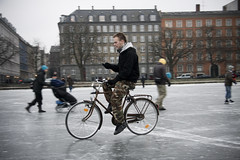
If you don't normally ride your bike during winter, this is a good week to try it. Taking a cue from their brothers-on-bikes in Copenhagen -- where cyclists, as a matter of course, write SMSes while riding one-handed on frozen ponds without helmets -- the Hungarian Cyclists Club is telling Hungarians to buck up and get on their bikes. Fair-weather cycling is for pussies.

The Bike to Work in Winter campaign runs all this week, with each day having a different theme and corresponding special event.

Since it's run by the government in partership with the Hungarian Cyclists Club, the campaign includes programmes throughout the country. But Budapest will be the center of activity, so if you're living in the capital, there will be plenty to take part in.

The campaign officially kicked off on Sunday with various organised recreational rides around the countryside. Then starting tomorrow, the workweek programme begins according to the following schedule of themes and events:


This is just to provide non-Hungarian speakers an idea of what's on offer. For more specific detail on places and times, check the Bike to Work homepage.

By contrast to the spring and fall Bike to Work campaigns, this winter programme DOES NOT involve a contest to see who can rack up the most kilometres. Neither does it require registration. It's a short but sweet programme to persuade people that transport cycling can be an all-weather activity. Just put on your hat and gloves, and before you get far you'll be warmer, and definitely more invigorated, than your car-commuting colleagues.