
The spring Bike to Work campaign is already started. Despite at least one reminder from a co-worker who forwarded me the above video, I missed opening day, just as I was caught off guard by the switch to Daylight Savings Time.
The campaign (held every spring and fall) began on Monday. If you're not signed up, you've actually only lost one day to log mileage (kilometer-age??). Contest rules allow you to log distances retroactively up to two days. Also, the campaign lasts til April 30, so you have plenty of time to catch the leaders.
The rules are pretty straight-forward: You register on-line with a team of up to four co-workers. Companies with more interest than that can register multiple teams. Once you're signed up, you just check off the days you commute by bike on the on-line cycling diary. Each individual team member logs his or her own commutes and the system automatically computes the cumulative distance for both you as an individual and your team as a whole. The website updates team standings daily to let you know how you're doing compared to other teams.
At the end, top teams get nice gifts such as bicycles, although with several thousand participants each year, getting the top spot requires serious dedication and/or a substantial outlay in anabolic steroids. Those of us whose performance can't even be artificially enhanced will have to settle for consolation prizes such as reflectors, bike seat covers and T-Mobile bandanas. Of course, the real point is not to win stuff but to have fun and get your butt out of its winter hibernation. I'll be rallying my troops tomorrow.
Wednesday, March 31, 2010


Sunday, March 7, 2010
Car-free holiday -- almost
For the past several winters, we've gone on family ski vacations somewhere in Italy or Austria and this has always been one of the rare weeks out of the year where we abandon our car-free ideals for the sake of speed and convenience. This year, however, we went some way toward rectifying the situation.
In Europe, it's actually quite possible to do a car-free ski trip. There are train and/or long-distance bus connections to virually all resorts and everywhere I've skied, I've always noticed local buses ferrying skiers up and down the mountain. However, at large ski areas, it's often the case that the only affordable accommodations are quite removed from the main roads. And while a half-kilometre walk to a bus stop wouldn't put me off in normal circumstances, it seems like a slog when I'm freighted down with gear and hobbling in ski boots.
This year, though, we went to a smallish resort in Carinthia a couple hundred kilometres south of Salzburg called Mallnitz. We found a decent, affordable pension in the middle of the village that was within a 5-10 minute walk of everything we needed: grocery store, restaurants, ski shop and even a swimming complex with sauna and jacuzzi. A free-of-charge ski bus left every 20 minutes in mornings and afternoons, offering a 10-minute connection to the closest alpine slopes. For those of us on a cross-country regimen, a nicely groomed circuit lied less than five minutes from our rooms in the village.
Our friends who drove us to Mallnitz from Budapest managed to go the whole week without using their car. Among other things, this meant they could have some wine or beer with lunch without worrying about European zero-tolerance drunk driving rules. But probably the nicest thing about Mallnitz was just being in the kind of place where a car is absolutely unnecessary -- a village that you can negotiate by sidewalk, checking out restaurant menus, shop windows and sale prices until something caught your eye.
As it turned out, we hadn't even needed the car to get to Mallnitz. We'd investigated rail options before our holiday, but made the mistake of consulting only the site for the Hungarian Rail Company, MÁV: there we could find only some really difficult connections. As we learned after our arrival in Mallnitz, there is more comprehensive information on the portal for the Austrian rail servoce, ÖBB. This shows daily trips in both directions lasting about eight hours -- almost on par with the car trip if you include rest and meal stops.
So as an experiment, my 5-year-old boy and I took the train for the return trip to Budpest. The train from Mallnitz to Salzburg was completely packed with vacationers, and became more so as we stopped at one ski resort after another up the Gastein Valley. We had an hour stop in Salzburg, and then boarded a brand-new, high-speed Austrian train called the Railjet. This is a fantastic way to travel, comfortable, quiet and clean ... and cruising along at 200 kph (127 mph) on countryside stretches. Aside from the aforementioned advantage of being able to drink -- an essential ingredient to any vacation in my opinion -- the Railjet also included a little "kinderkorner" with a TV showing and endless loop of Disney cartoons. The whole trip from Mallnitz to Budapest wast just EUR 60, including the free-of-charge ticket for my boy.
It seems the longer I go without regularly using cars, the less I like them -- the tight space, the lack of air, the fact you're moving so fast with nothing but flimsy metal panels and tempered glass between you and disaster. This last trip opened my eyes to an excellent holiday option that doesn't require a car. We were so psyched about the trip that we're already planning a return in summer -- and this time bringing our bikes.
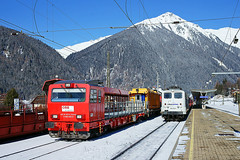
In Europe, it's actually quite possible to do a car-free ski trip. There are train and/or long-distance bus connections to virually all resorts and everywhere I've skied, I've always noticed local buses ferrying skiers up and down the mountain. However, at large ski areas, it's often the case that the only affordable accommodations are quite removed from the main roads. And while a half-kilometre walk to a bus stop wouldn't put me off in normal circumstances, it seems like a slog when I'm freighted down with gear and hobbling in ski boots.
This year, though, we went to a smallish resort in Carinthia a couple hundred kilometres south of Salzburg called Mallnitz. We found a decent, affordable pension in the middle of the village that was within a 5-10 minute walk of everything we needed: grocery store, restaurants, ski shop and even a swimming complex with sauna and jacuzzi. A free-of-charge ski bus left every 20 minutes in mornings and afternoons, offering a 10-minute connection to the closest alpine slopes. For those of us on a cross-country regimen, a nicely groomed circuit lied less than five minutes from our rooms in the village.
Our friends who drove us to Mallnitz from Budapest managed to go the whole week without using their car. Among other things, this meant they could have some wine or beer with lunch without worrying about European zero-tolerance drunk driving rules. But probably the nicest thing about Mallnitz was just being in the kind of place where a car is absolutely unnecessary -- a village that you can negotiate by sidewalk, checking out restaurant menus, shop windows and sale prices until something caught your eye.
As it turned out, we hadn't even needed the car to get to Mallnitz. We'd investigated rail options before our holiday, but made the mistake of consulting only the site for the Hungarian Rail Company, MÁV: there we could find only some really difficult connections. As we learned after our arrival in Mallnitz, there is more comprehensive information on the portal for the Austrian rail servoce, ÖBB. This shows daily trips in both directions lasting about eight hours -- almost on par with the car trip if you include rest and meal stops.
So as an experiment, my 5-year-old boy and I took the train for the return trip to Budpest. The train from Mallnitz to Salzburg was completely packed with vacationers, and became more so as we stopped at one ski resort after another up the Gastein Valley. We had an hour stop in Salzburg, and then boarded a brand-new, high-speed Austrian train called the Railjet. This is a fantastic way to travel, comfortable, quiet and clean ... and cruising along at 200 kph (127 mph) on countryside stretches. Aside from the aforementioned advantage of being able to drink -- an essential ingredient to any vacation in my opinion -- the Railjet also included a little "kinderkorner" with a TV showing and endless loop of Disney cartoons. The whole trip from Mallnitz to Budapest wast just EUR 60, including the free-of-charge ticket for my boy.
It seems the longer I go without regularly using cars, the less I like them -- the tight space, the lack of air, the fact you're moving so fast with nothing but flimsy metal panels and tempered glass between you and disaster. This last trip opened my eyes to an excellent holiday option that doesn't require a car. We were so psyched about the trip that we're already planning a return in summer -- and this time bringing our bikes.
Tuesday, February 16, 2010
Right winger stumps for cycling
The presumed next mayor of Budapest, István Tarlós of the center-right Fidesz party, gave some nice but predictable lip service to the cause of city cycling at a campaign event earlier this month.
As reported on caboodle.hu, the current mayor of Óbuda had this to say:
My skepticism is partly a superficial impression. Tarlós ran against Demszky four years ago, and in his campaign posters, he was always this hulking, unsmiling figure in a dark suit. He was the picture of either a mafia don or a rather unsympathetic director of a funeral parlour. In one poster, he was surrounded by several archetypal urbanites, including a fit, young woman on a bicycle. Even in this poster, Tarlós was unsmiling in his big, dark suit -- it was unimaginable that he could have any personal connection with anyone else in the photo. The visual dissonance was so stark, it created the impression that the picture was Photoshopped even though it (probably) wasn't.
For the current campaign, Tarlós has lost the suit and his bottle-blonde hair has been tousled -- probably by his hair dresser. However, the last bit of sloganeering I heard from him was characteristically right wing: something to do with "security and economic development" for Budapest. Let's hope the bicycling talk was more than just a compulsory campaign drill to appease some of his centrist detractors.
As reported on caboodle.hu, the current mayor of Óbuda had this to say:
Traffic in the capital should be viewed as an integrated system, within which cyclists must be treated as equal partners, Tarlós said, adding that "the right proportion should be established between cars and bicycles."Not to be cynical, but Mayor Demszky has also, over the course of his 20-year sway as city mayor, waxed lyrically about the virtues of cycling and the need to do more for our cause. The difficulty has always been in execution, particularly in cases where motorists had to be confronted. I doubt that any longtime followers of cycling politics were seduced by Tarlós's words. We'll have to see how they're embodied in action.
My skepticism is partly a superficial impression. Tarlós ran against Demszky four years ago, and in his campaign posters, he was always this hulking, unsmiling figure in a dark suit. He was the picture of either a mafia don or a rather unsympathetic director of a funeral parlour. In one poster, he was surrounded by several archetypal urbanites, including a fit, young woman on a bicycle. Even in this poster, Tarlós was unsmiling in his big, dark suit -- it was unimaginable that he could have any personal connection with anyone else in the photo. The visual dissonance was so stark, it created the impression that the picture was Photoshopped even though it (probably) wasn't.
For the current campaign, Tarlós has lost the suit and his bottle-blonde hair has been tousled -- probably by his hair dresser. However, the last bit of sloganeering I heard from him was characteristically right wing: something to do with "security and economic development" for Budapest. Let's hope the bicycling talk was more than just a compulsory campaign drill to appease some of his centrist detractors.
Sunday, January 24, 2010
Riding in a Wintry Wonderland
Bicycle Ice and Texting
Originally uploaded by [Zakka / Mikael]
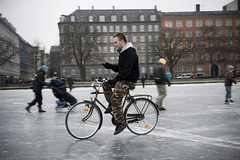
If you don't normally ride your bike during winter, this is a good week to try it. Taking a cue from their brothers-on-bikes in Copenhagen -- where cyclists, as a matter of course, write SMSes while riding one-handed on frozen ponds without helmets -- the Hungarian Cyclists Club is telling Hungarians to buck up and get on their bikes. Fair-weather cycling is for pussies.
Originally uploaded by [Zakka / Mikael]
If you don't normally ride your bike during winter, this is a good week to try it. Taking a cue from their brothers-on-bikes in Copenhagen -- where cyclists, as a matter of course, write SMSes while riding one-handed on frozen ponds without helmets -- the Hungarian Cyclists Club is telling Hungarians to buck up and get on their bikes. Fair-weather cycling is for pussies.
The Bike to Work in Winter campaign runs all this week, with each day having a different theme and corresponding special event.
Since it's run by the government in partership with the Hungarian Cyclists Club, the campaign includes programmes throughout the country. But Budapest will be the center of activity, so if you're living in the capital, there will be plenty to take part in.
The campaign officially kicked off on Sunday with various organised recreational rides around the countryside. Then starting tomorrow, the workweek programme begins according to the following schedule of themes and events:

This is just to provide non-Hungarian speakers an idea of what's on offer. For more specific detail on places and times, check the Bike to Work homepage.
By contrast to the spring and fall Bike to Work campaigns, this winter programme DOES NOT involve a contest to see who can rack up the most kilometres. Neither does it require registration. It's a short but sweet programme to persuade people that transport cycling can be an all-weather activity. Just put on your hat and gloves, and before you get far you'll be warmer, and definitely more invigorated, than your car-commuting colleagues.
Monday, January 18, 2010
Welcome Back, BKV
 Strike's over. During the weekend, the management of Budapest's public transport company BKV agreed to give workers pretty much everything they'd asked for, which is to say, everything that was taken away in the renewed collective contract.
Management didn't have a chance in winning the fight. During the last year, one corruption scandal after another befouled the already dubious name of BKV management. Among the most recent cases, there were several lavish severance packages given to BKV officers with hardly any tenure and millions of forints worth of legal service contracts given to firms that did no work.
To read the news, BKV managers seemed like nothing but a bunch of crooks, so when they tried to patch up finances by eliminating employees' hot-meal tickets, you couldn't help but want to punch someone in the face. It's a shame that a few greedy managers have done so much to undermine the reputation of BKV. Public subsidies are necessary for public transport to function, so when the people's good will dries up, so does the service.
We cyclists may be less reliant than most on public transport but I, for one, like to have it in a pinch. I blogged earlier about how I'd hurt my knee over the holidays and haven't been able to bike. BKV was my stand-in for a few weeks, and then the strike hit. Last week, I joined hundreds of others for half-hour waits on HEV platforms and more than a couple claustrophobic rides on the 4-6 tram line.
In some circles, it's heresy to say this, but the bike alone is not enough for me to live car-free. Having a functioning public transport system has been key, and this past week I missed it.
Saturday, January 16, 2010
Bikes a Cheap Bailout from Strike
 Apparently, the public transport strike really is getting more people on bikes. I'm in the market for a cheap (read: disposable) used bike so yesterday I stopped by my local bike shop. It's a tiny, window-front store (Blue Cet kerékpárbolt at Török u. 5) and has space for no more than 20 bikes, including a few that are chained up on the sidewalk out front.
They didn't have anything I wanted, partly because there's been a run on merchandise since the BKV strike began Monday. In five days, the store's sold at least 10 bikes to commuters desperate for a stop-gap alternative to BKV. A run like that is unheard of in January, the owner told me.
A terrific mainstream endorsement for biking the strike appeared in Thursday's edition of Metropol Budapest. On an inside spread with the daily sztrajk update were a few paragraphs on how two college students, Nikoletta and Cecile, were coping. A picture shows the pair standing on a tram platform, all bundled up in knit scarves, with one holding a bicycle. The caption reads simply: "She went by bike."
In the article, Cecile explains that the Budapest strike hasn't been difficult compared to the last one in her native France. Here, most lines of transport are still running, though with less frequency. In France (presumably, during the last strike in fall, 2007), public transport nearly shut down completely.
This brings to mind an odd thing I noticed about the strike. It doesn't seem to have caused much in the way of chaos. The first morning, as I mentioned in my first post on the strike, there were traffic jams and the sidewalks were packed with involuntary pedestrians. But the next morning, car traffic, at least in Buda, was almost normal. The crowds had also diminished on the the suburban train to Szentendre (HÉV). The only place where I've consistently run into uncomfortable congestion is on the slow-downed 4-6 tram line.
All this has made me wonder if there are lots of people who are simply staying at home. I reckon most workers can do this for a few days without straining relations with their bosses. However, as the strike drags on, pressure will increase to find ways to get to work -- especially, as public transport and the road network -- not to mention local bike routes -- DO seem to have unused capacity. It'll be an interesting week ahead.
According to the latest news, worker unions and BKV management are still at loggerheads with no progress in negotiations since the get-go. The strike, already the longest in Hungary in 10 years, was to continue indefinitely.
Tuesday, January 12, 2010
Cyclists Strike Gold with Transit Slow-down
 Budapest public transport workers went on strike this morning, leading to the predictable traffic jams and opportunistic truancies among city workers. I myself am working at home today. Although it's a limited strike, creating a slow down rather than a freeze at the BKV transport company, this morning's long trek to my son's daycare persuaded me that it'll be best to avoid cross-town travel.
In Budapest, public transport commands a 55 percent modal share, which means a transit strike can have devastating consequences. However, transport cycling advocates anticipate these events with perverse glee because they force people to consider, and try out, alternative means of transport.
Naturally, most people who take up cycling as a way to cope with a transit strike will go back to their regular means of transport once the crisis subsides. But under certain conditions cycling gains can be locked in. It all depends on what kind of experience the crisis cyclists have during their two-wheeled foray around the city. A text book example occurred in Paris in 1996 when public transport workers went on a strike for a month. Rush-hour traffic in Paris is awful under normal conditions, but with the metro shut down, the city's boulevards froze solid. Many people who tried to use cars to get to work found themselves stuck in traffic for hours on end. With cars an unrealistic option, commuters began to bike, walk and, being Parisians, roller-blade.
Serendipitously, Paris's new mayor had just launched an ambitious programme to encourage transport cycling in the city. Bike paths were being built and cycling NGOs were working at fever pitch to promote their cause. When the strike was over, they were prepared with a publicity campaign about planned cycling developments to encourage strike cyclist to stick with their bikes. In the years since, cycling levels in Paris have jumped dramatically -- and advocates credit the transit strike for providing that first spark.
Similarly, a public transit strike here in Budpest in April of 2008 is credited with accelerating a rise in cycling levels that began circa 2004 with the first big Critical Mass rides. Who knows how much it contributed, but at the time the Kerekagy blog reported record numbers of cyclists in the city.

It must be said that one of the contributing factors to the big cycling numbers during the 2008 strike was the pleasant spring weather. By contrast, the kick-off of this latest strike coincided with a major drop in temperature. Until a day or two ago, we were having unseasonably mild temperatures in the mid-teens (Celcius), but this morning it was below freezing.
Despite that, I noticed a few newcomer cyclists along with the usual hardcore winter riders when I got out this morning. On my way up Romer Floris utca, the steep street leading to Lance's day care, I normally see just one other cyclist -- it's a pretty steep street, and therefore, not a favoured bike route. But this morning, I spotted three others. On Margit körút, there were several cyclists riding on the sidewalks: newcomer, strike cyclists, I figured. The usual winter riders are hard-core types who ride with car traffic on the carriageway.
The main impact on traffic, however, was not a rise in cycling levels but rather a rise in car traffic (bad) and foot traffic (still good).

 The increase in foot traffic was especially noticeable on Margit bridge. Normally the 4-6 tram is the quickest way across the span (with a major renovation going on, private passenger cars are banned). The 4-6 carries more than 300 people at a time and during normal operations it departs about every 2-3 minutes during rush hour. But this morning people had to wait up to 10 minutes. Perhaps because of the cold weather, a huge number of people chose to hoof it instead. Nothing like a brisk walk to ward off the chills.
Subscribe to:
Posts (Atom)


 Posts
Posts


