Monday, January 16, 2012

Diversion Time

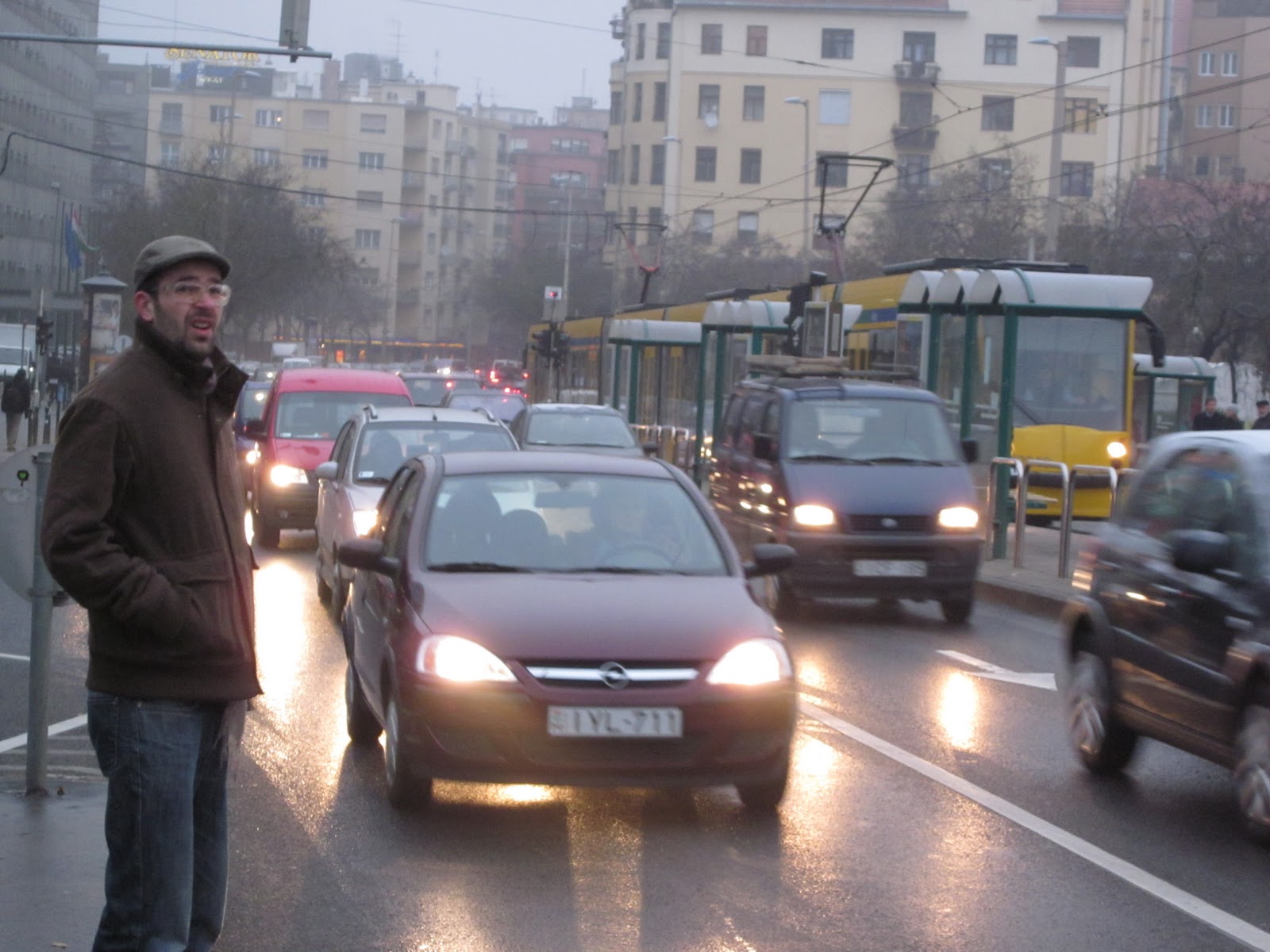
BKV: Not a particularly diverting experience, either.
For the past several weeks, local news sites have been chronicling the financial crisis facing Budapest public transport company BKV. With payment deadlines on several huge loans coming up next month, a day of reckoning is drawing near, and BKV's prospects look dismal from every angle: they don't have enough money of their own and their would-be backstop, the Hungarian national government, can't handle its own problems, let alone Budapest's. And in any case, Prime Minister Viktor Orbán has little incentive and far less good will to stick his neck out for political independent István Tarlos, the capital's mayor.

Anyway, Erik D'Amato lays out the state of play in a thoroughgoing post on caboodle.hu. The article sums up the financial and political aspects of the story, and takes the added step, seldom taken by Hungarian journalists, of considering the impacts on "you the reader." If the crisis does devolve into a transit worker strike and service shutdown, hundreds of thousands of people will be stuck without their usual mode of transport.

Erik mentions an index.hu survey on what mode of transport readers would use in case of a BKV shutdown. The #1 response (by a 2-1 margin over #2, a private car): the bicycle. Erik editorialises:
"(That's) something that might be a fun temporary diversion in summer, but hardly one in the dead of a Central European winter."
On the contrary, I imagine the Index readers fully appreciate the challenges of riding a bike in a Central European winter: You need to dress warmly and you need to beware of slippery spots when it's below freezing. Not a big deal. Commuters in Denmark and Sweden bike through winters that make the ones here seem like a trip to the Király baths: a little dank and gloomy, perhaps, but generally pretty warm.

I can imagine a Scandinavian reading Erik's comment about the fear of cycling in the "dead" of one of our winters, and thinking. "What a bunch of wussies!" Just the same thought occurred to me this morning as I was bumping down the tracks on the HÉV by Pannonia telep. I looked out the window and noticed a woman about 65-70 years of age bicycling along on the road next to us. She was bundled up in a scarf and big ski parka, and, although her determined expression did not suggest  she was having "a fun temporary diversion," neither did she seem in an advanced state of hypothermia. I imagine she was regarding all of us in the HÉV, and thinking, "What a bunch of wussies!"

That said, I don't look forward to a BKV shutdown. The system carries approximately 55-60 percent of city traffic in downtown Budapest, so you can't take it away without causing major problems.

On Friday, as a first condition of getting emergency government subsidies for BKV, Mayor Tarlos submitted a plan to secure the long-term financial sustainability of the public transport system. Along with fare hikes, the plan calls for the implementation of an inner-city congestion charge and the establishment of a network of park and rides on the congestion zone's periphery. These ideas were mooted several years ago by former Mayor Gábor Demszky, but there's never been any action on them. Just as the city has made no real attempt to achieve its stated goal of a 15% modal share for cycling by 2015.

If there will be a silver lining to the BKV crisis, it may be that it will finally kick-start some ad hoc action on the city transport system's strategic development.


Wednesday, January 11, 2012

Winter: It's not Just for Drinking Anymore

Winter in Copenhagen, a shot from the blog Copenhagen Cycle Chic.
I hate to start a new year on a negative note -- so I'll save that for post #2. This first post will focus on a little ray of sunshine from a place that doesn't have much of that this time of year -- Denmark. A photo exhibition of Copenhagen's renowned cycling culture will be held Thursday evening at the Európa Pont at Millenáris Park. It'll be a selection of 50 photos by Denmark's most prolific cycling shutterbug Mikael Colville-Anderson. Readers will know him as the blogger behind Copenhagenize.com and Copenhagen Cycle Chic.

Putting a local spin on the event, the Hungarian Cyclists' Club will follow up with a workshop on winter cycling. Very timely subject matter considering the threat of bankruptcy now facing Budapest public transport company, BKV. Those who haven't saddled up since September might consider pumping up their tires. At the workshop, bike club President János László and COWI Magyarország engineer and cycling expert Péter Dalos will preside.

After that, the local blog, Hungarian Cycle Chic, will host a fashion show featuring the clothes and cycling accessories of various local and international designers and manufacturers.

An English description of the photo exhibition, entitled "Monumental Motion" and being staged in various cities throughout the year, is here.

What: Cycling photo exhibition and winter cycling programme
When: 6-9 p.m. Thursday
Where: Európa Pont, Millenáris Park, 1024 Budapest, Lövőház u. 35.


Thursday, December 1, 2011

We're going for ... a walk. God help us!!

Today at school, our boy got a gift from the II. District government: a fluorescent lime safety vest meant to wear whenever he's walking or bicycling in the city.
The II. District is looking out for me! But missing the point.
It came with a note, signed by the district mayor, explaining that "the safety of children is the responsibility of adults -- our responsibility." And continued that children get into accidents more easily and, regrettably, more frequently, and they make up the majority of those involved in accidents as cyclists or pedestrians.

And while noting that increased attention is needed on the part of motorists, the letter emphasized that it is necessary to develop proper travel behaviour among children in the interest of avoiding accidents.

The letter concludes by noting that because a parent "can't be next their child every second," this reflective vest can provide a useful, effective service by helping the little ones (a kicsik) to draw attention to themselves from motorists.

I feel bad whinging about this, because I believe this gesture came from a good place and, of course, I'm grateful that the local önkormányzat considers the safety of local children a priority.

At the same time, I feel myself recoiling from this unsolicited advice just as I do when older Hungarian women offer to help with our little daughter whenever we're out in public. If you're a parent, you're familiar with the issue. You're out with your baby on a perfectly pleasant summer day, but a square centimetre of her abdomen is exposed to the air -- the air!! -- and so an endless succession of kind-hearted women accost you to express pity for your child and ask if you don't think your baby's freezing.

It's the same thing with the protective vest. The sentiment is nice, I suppose, but it reflects a quaint, wrongheaded approach that doesn't do anything to help my child. If the mayor's really interested in helping, he needs to know that the main transport hazards that Lance faces on the streets of this district are from fast-moving cars. Of course both my wife and I work to instill safe walking and cycling behaviour in him, as we would anywhere. But this city, including this district, has a problem with traffic speeds. A city is no place for an expressway, but Budapest is full of urban expressways that don't allow for the slimmest margins of error for a rambunctious child on a sidewalk.

I love the small of a traffic jam in the morning!
 The main hazard Lance and I face everyday in District II is the traffic on Margit körút. This street is a typical four-lane, Budapest expressway, and it runs between our flat and the turnoff to Lance's school. Lining the street are dozens of apartment blocks, a park with playgrounds, restaurants and bakeries, a cinema, three grocery stores and the Mammut shopping mall -- places that attract droves of "little ones". The körút is also the route of the city's most heavily used tram line, which ferries hundreds of children and their parents to and from schools, kindergartens and daycare centres located just off the körút. This corridor teems with pedestrians of all ages every rush hour, and yet, the vast majority of space on the körút is devoted to car traffic and the cars rush by at ridiculous speeds.

In my view, the best way to enhance children's safety on the streets of II. District would be to calm the traffic. On the körút, the sidewalks could be widened, bike tracks added on both sides of the street and motor circulation restricted to one lane in each direction. But most importantly, the speeds could be slowed down to 30 kph. Studies have been shown that speed reduction is one of the most effective ways to avoid accidents and reduce the incidence of serious injuries and fatalities. 

Ironically, I occasionally don one of these ugly reflective vests while cycling at night in Budapest. And I see more and more cyclists in Budapest wearing these things -- during the night and day. I think this is profoundly wrong -- you shouldn't have to dress up like a emergency-services worker to ride a bike. And now, the district government is advising parents to put these things on their children whenever they set foot on a district sidewalk. Is this not a sign a problem?

Postscript: Despite my philosophical quibbles with the District II's child-safety scheme, Lance couldn't wait to put his new vest on this morning. Later,  I had cause to puzzle about this apparent enthusiasm. He wore it on our bike ride to school. But when I dropped him off at the front gate, he took off the vest and handed it to me. I didn't understand -- why didn't he just wear it into the school and take it off in the class room, along with his coat and mittens? He said he didn't want to -- he wanted me to take it home. Then I teased him: C'mon Lance, you're teachers will say you're a bright student. I can't resist stupid word plays. And it made Lance cross with me. At any rate, for some reason, he did not want his friends to see him in that vest. At seven years of age, he's more fashion conscious than he once was, and this vest apparently sets him apart in an unpleasing way. Maybe he thinks it makes him look like a momma's boy. I'm not sure, but he's definitely got some reservations about this thing.

Lance dons the safety vest. But will it be a
short flirtation with fluorescent fashion?

Wednesday, November 30, 2011

Warsaw Uses Common Sense on Bus Lanes

The city of Warsaw, never known as cycling paradise, has taken a step that Budapest's authorities have stubbornly resisted: allowing bicyclists to use bus lanes.

In Budapest (and throughout Hungary) the default rule is that bicycles cannot ride in bus lanes on the grounds that the lanes are too narrow to safely accommodate both modes of transport (nevermind that taxis have carte blanche here).

On rare streets where there is an abundance of width, authorities, if they choose, can post bike signs and/or mark bike lanes that allow for an exception.

However, on most bus priority streets downtown (e.g. on Árpád fejdelem and an Erzsébet híd-Rákóczi út), buses hold sway in the curb lane and cyclists are required to ride in the second lane over, where they're being passed by buses on their right and other traffic on the left. Here's an illustrative video.

In Warsaw, authorities have recognised the absurdity of this situation. Whatever challenges might be posed by opening bus lanes to cyclists, it's more dangerous to force them between lanes of faster-moving traffic. In addition, the Warsaw authorities reasoned that because cyclists make up a relatively small share of traffic (as in Budapest, like it or not), the disruption to bus traffic will probably be tolerable. Warsaw will therefore open one bus lane to cyclists and other single-track vehicles on the trial basis, and then expand the idea depending on results.

In Budapest, so far, they've been very dogmatic about lane-width requirements -- even to the point of creating a dangerous situation for cyclists. The city should follow Warsaw's common-sense approach, and see if a more permissive policy works on an experimental basis.


Wednesday, November 23, 2011

Illuminating result


Image from fall 2011 Critical Mass borrowed from here.
The results are in from Budapest's latest "ninja" count -- and it shows a significant uptick in the use of bike lamps compared springtime.

As you may recall, the organisers of the city's Critical Mass carried out a pilot survey of bike-lamp use this past March. Volunteer counters across the country observed more than 2,000 cyclists and found that 57 percent were in perfect compliance with requirements (having both front and rear lamps); 77 percent had at least one light (front, rear or both); and 23 percent were riding ninja style, with no lamps at all.

Last week, a follow-up survey was carried out and the improvement was remarkable. The share of cyclists in perfect compliance was up by 12 points to 69 percent; the portion with at least some lighting was up nine points to 86 percent; and the number of “ninjas” was down by nine points to 14 percent. The spreadsheet with the full dataset is available on Google dox here.

In his post on the count, lead organiser Gábor "Kükü" Kürti enthused about the "very positive" results, although cautioning that a more proper comparison will have to wait until March, when numbers can be compared from spring to spring.

Some comments to Kükü's post expressed skepticism that the result could be completely attributable to behavioural change. I'd have to agree that such a major change in mindset and habits would be unlikely to occur in just six months' time.

I was thinking there could be a few other possible explanations:
  • In springtime, you have a lot more fair-weather cyclists who are riding bikes fresh out of storage and, naturally, with dead batteries in their lamps. Whereas in fall, the riders have been riding continuously all summer and their equipment, including lamps, is mainly in working order.
  • Over the last couple of seasons, there's been a huge, and rapid improvement in the bike lamps on offer. The latest LED lights, with multiple diodes, have huge candle power and the batteries never seem to run out. At the same time, Hungarian bike shops are offering more and more commuter-style bikes that are pre-equipped with front and rear lamps powered by dynamos. It could very well be that the better offer on the marketplace has had a positive impact on lamp use even during the last six months.
  • More optimistically, we all know there have been lots of new people taking up cycling during the last couple seasons. It could be that these relative latecomers to everyday cycling are generally more safety-conscious than the more kemény mag (hardcore) types who dominated the scene earlier. At any rate, I've noticed a lot more cyclists during the last season or two who are wearing reflective vests and jerseys, along with headlamps and other lights, than I used to.
Whatever the cause of the increase, it seems to me that even last spring's results were positive enough to disspell the prejudice that cyclists are a bunch of heedless sociopaths. Even the first survey showed that the overwhelming majority of night riders had at least one working lamp on their bike. That indicated to me that most people want to ride safe -- even if only for selfish reasons of personal security. The fact that some of these had a missing lamp or one with dead batteries is not a sign of willful disregard of the law or public safety. At worst, it's a sign of procrastination or forgetfulness. 

The latest survey gives hope that there's something afoot that's influencing more people to ride with working lamps. It'll be interesting to see if the good numbers hold up in the springtime.


Wednesday, November 16, 2011

Second Periodic Nationwide Ninja Count

The guys at criticalmass.hu are organising a nationwide bike-lamp count tonight from 7-7:20. They're seeking volunteers to stake out positions on local bike routes during this time window and count all passing cyclists and the extent to which each one complies with traffic code requirements on lighting.

This is the second time such a count has been done; the first was conducted last March. In that one, volunteers took counts at 85 sites, 48 in Budapest and the rest in 21 smaller towns and cities. In total, 2,461 cyclists were counted. The overall result was that 57 percent were in perfect compliance with the rules, having functional front and rear lamps; a further 20 percent had one good lamp (either front or rear); and 23 had no lamp at all ("bike ninjas" in the bike-world parlance).

As Critical Mass organiser Gábor Kürti noted in his post about these results, one of the main causes of accidents involving cyclists is that the cyclists simply aren't noticed. Few would argue that having lamps can help alleviate the problem -- at least at night time.

The 23 percent of cyclists riding around as ninjas is far too high, in Kürti's opinion, and he hopes these regular counts, once or twice per year, will help raise awareness of the problem and track its evolution.

If you'd like to take part in the count, it's quite simple. The directions, in Hungarian, are given here:


Saturday, November 5, 2011

Accident waiting to happen ... happens again

About a week after posting about an accident at "the most dangerously located bike/pedestrian crossing in the city," I came upon this frightening scene at the very same intersection. I don't know any details about what happened. I noticed the wreckage during my morning ride to work, and I reckon it happened the night before.    


From the visible evidence, it was apparently a single-car collision (an Opel logo and bits and pieces from a radiator are strewn about next to the mangled guard rail and stop sign). 


This is the bike path crossing of Újlaki rakpart (recently renamed "Slachta Margit rakpart," between Timár utca and Árpád híd). The problem with it is that it's right in the middle of zigzag of the street: essentially invisible to motorists coming from either direction until they get within about 20 metres. The only way to approach it safely is to go very slow, although the speed limit on Újlaki is 50 kph -- and average speeds are 60-70, I would guess.


So within the space of a week, I was witness to two accidents at the very same intersection (or, at least, one accident and the aftermath of a second). What are the chances of that? I'm interested to know if local authorities keep track of accident hotspots and whether or not this makes the hot 100.