Showing posts with label Car Free Day. Show all posts

Thursday, September 13, 2012

Critical Mass "leaving slowly"

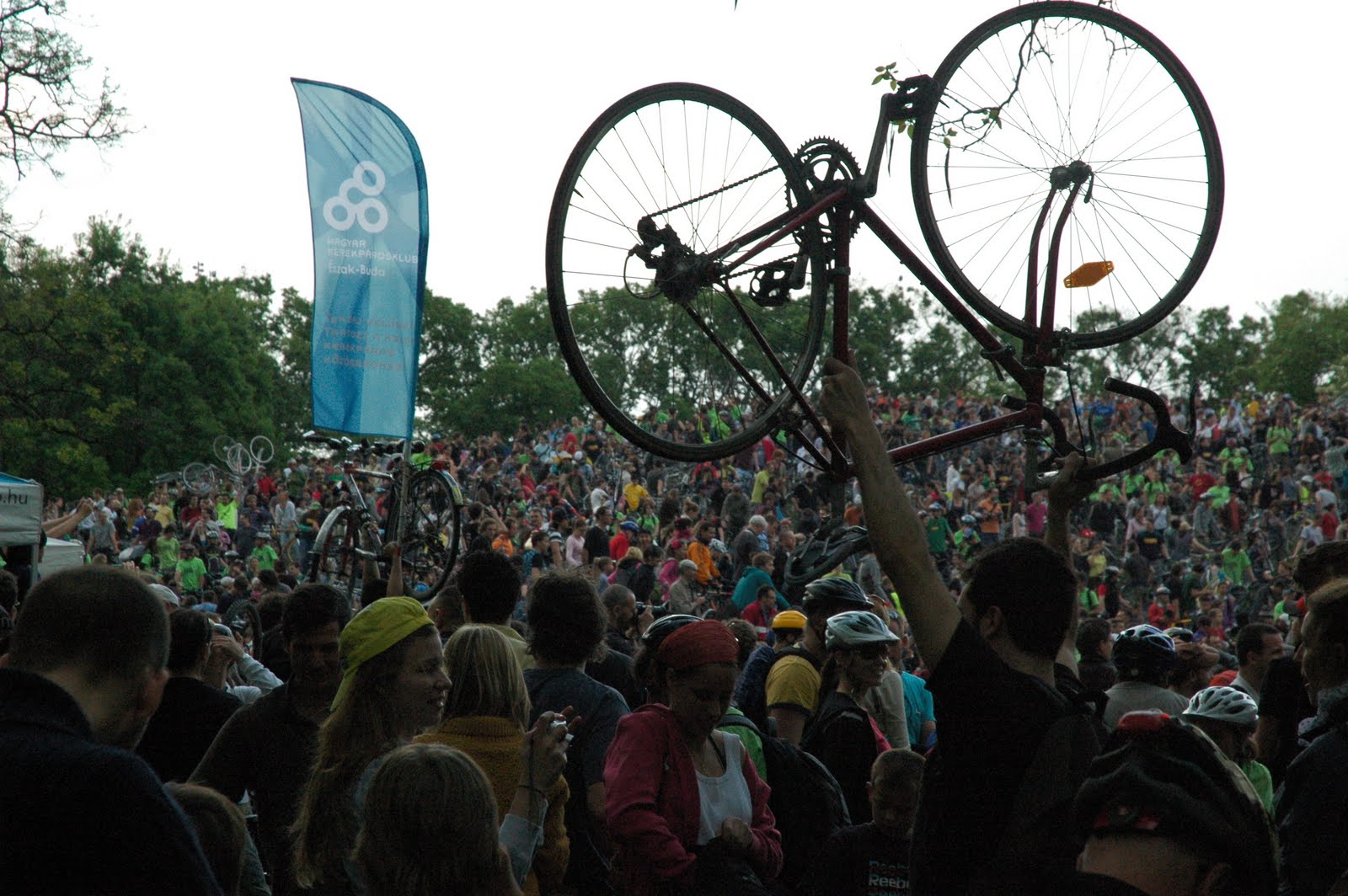
Critical Mass, shortly after it was called off the first time.
Everyone must know by now, but for posterity's sake I'll note it here anyway: the fall 2012 Critical Mass has been cancelled, and, according to organisers, they'll hold just one more ride next year before the CM closes for good.

The organisers, Károly Sinka and Gábor Kürti, head honchos of bike couriers Hajtas Pajtas, have been publicly mulling a shut-down since spring of last year. Since then, three more CMs transpired with little said about when they'd make good on their threat. As noted, one more CM is already planned, for spring of 2013, and in Sinya's and Kuku's follow-up comments on the Web, they do not rule out "reunion tours" in the future. So if this is really goodbye, it's shaping up to be a long one (and a quintessentially Hungarian one, too. According to local custom, social events never end abruptly. Guests typically take a half hour or longer between announcing their departure and actually departing. "Lassan megyünk," they say: "We're leaving slowly.").

That said, it DOES sound like the organisers are more resolved this time. In the the announcement at criticalmass.hu and in a follow-up interview on the kerekagy blog, Sinya and Kuku said the ride had run its course. They noted that during the early years, CM could rightly take credit for the rising levels of everyday cyclists in Budapest. At one point, according to their surveys, nine of 10 cyclists on Budapest streets credited CM for getting them in the saddle. By now, the statistic has flipped: just one in 10 credits CM, with the rest riding for various other reasons.

A major point the two activists make is that CM has become a distraction from the more important work of professional lobbying, in particular, that done by the Hungarian Cyclists Club (Magyar Kerékpárosklub - MK). The two view CM first and foremost as a lobbying tool, and while Critical Mass and the cycling club were once an effective double act  -- CM lending the brawn, MK the brains  -- it's no longer so, they say. With so many cyclists on the streets everyday of the week, CM has become redundant. "Now voters are already bicycling," Sinya said in the kerekagy piece. "Cycling is no longer a subculture."

The two believe that CM even undermines the bike club. Riders can join a free-of-charge Critical Mass once or twice a year and feel they've done their bit to advance cycling. But Kuku and Sinya say the most fruitful bike lobbying is done by MK, and MK needs money -- desperately. The club has teetered at the edge of insolvency for two years, as EU project opportunities dry up and contract payments get held up. One of the club's most popular initiatives -- the Bike to Work campaign (Bringazz a Munkaba -- Bam) -- lost a significant subsidy from the Hungarian government a year ago or so. Financial stability requires a bigger base of individual memberships, they say: The current pool of 1,500 is just half of what's needed.

---
For myself, I completely respect the organisers' wish to direct their energies elsewhere. And there's no doubt that CM Budapest is past its prime. Participation peaked out more than four years ago. The numbers these days are still very respectable, but we can expect them to slide. Why not quit before they do?

I also agree that the cycling club needs all the support it can get. Yet I wonder how canceling CM will help. The average CM participant, I believe, comes out for a good time and to rub elbows with fellow enthusiasts. Buying a cycling club membership is not going to satisfy that social itch.

It's my personal view that CM should be handed over to a new organisation, one that would develop it into a festival. In recent years, this is how CM has been trending anyway -- with the after parties sponsored by the Dutch Embassy, the free classical concert last fall, and the several fashion show side events by Hungarian Cycle Chic, etc. CM -- or CM's successor -- could be further developed with more attractions, commercial sponsorships, a professional fund-raising drive and so on.

In fact, Sinya and Kuku have considered this same sort of handover, but they're not very convinced. In the kerekagy piece, Sinya remarked that he had attended a similar sort of event in Berlin, but didn't see it as a model to follow. "There wasn't a problem with it, but with such an event, nothing can be achieved," he said.

Nonetheless, I assume there's a big constituency that would like to give it a go. There are many models to follow. Besides the one in Berlin, there is the American Tour de Fat, for example. This is a series of cycling events in several different cities sponsored by the New Belgium Brewing company (makers of Fat Tire ales). Tour de Fat events include a cycling parade (like CM), concerts, cycling competitions and exhibitions and more. The Tour de Fat in San Franciso is probably typical: it's organised and staffed by volunteers from the local cycling coalition and it attracts about 6,500 people. All proceeds from beer sales (the beer supplied for free by the sponsor) go to charity. Admission  is free, though participants can give a voluntary contribution of USD 5 (about HUF 1,000) to the cycling coalition.

This sort of event could be organised relatively easily in Budapest. The community, the  know-how, and the tradition of CM are already established. With a fresh perspective and new energy, this could just be what the CM community needs after eight years of serious demonstrating..


Wednesday, September 23, 2009

Budapest Critical Mass Back on the Rise

Some 20,000 cyclists participated in last night's Car-Free Day Critical Mass, according to the national news service MTI and Figyelőnet. This is double the figure of last fall's Critical Mass and a point worth pondering as we wind down from the euphoria of it all.

As followers of the local cycling scene will remember, the Car-Free-Day Critical Mass has taken on a very different personality from the parade-like, family event that is the Earth Day ride. In spring of 2008, a record 80,000 showed up, and this astounding turnout made all of us Budapest cyclists proud. At the same time, I know of more than a couple fellow travelers who decided then and there that the whole Critical Mass thing had become too popular to bear: people realised that getting stuck in a queue of that magnitude can take a toll on your revolutionary gusto.

For the die-hards, myself included, last year's Car Free Day Critical Mass was a welcome break from the safe-as-milk variety of rides which, while charting huge attendance figures, seemed too tame to effect much change.

Last year's ride drew just just 10,000 participants (only half of whom were on hand for the concluding bike lift), but at least we were riding in normal traffic without police escorts to nanny us through the route. And with the significantly diminished crowd, there was the practical advantage of being able to ride at normal speeds in a nice, sparsely arrayed procession that got us to the end in good time.

This year, though, the lack of police escort and the warnings for families with kids to stay away (or at least go instead with a side event, Kidical Mass) did nothing to suppress turnout.

My wife, Kristin, our five-year-old boy Lance, and I showed up at the starting point, City Hall, about 6 p.m. It was a mad house. The streets on all sides of the several-block municipal complex were congested with cyclists. We stopped at the northwestern corner of the site and didn't even try to venture further.

It brought me back to the ridiculously congested critical masses of years gone by. Even when the procession started, you could barely move. More often, you were walking your bike ... and waiting ... and walking ... and waiting ... and walking a bit further.

But the sluggishness of the last night's ride was testament, first and foremost, to the popularity and power and inevitability of the bicycling movement in Budapest. After a couple of tepid turnouts during the last year, last night's enormous turnout showed that Budapesters have an abiding love for cycling, and they're going to keep coming out for demonstrations, and keep biking on a daily basis, regardless of the crap support they get from City Hall. Budapest cyclists have emerged as a significant constituency that, far from being a fad, is going to grow and grow and grow.

Like a rising flood, the city's population of everyday cyclists will surround our decision makers and force them to ever higher, ever dwindling bits of dry land. Eventually, even our city leaders will learn there's no point in building dikes in marshland. They'll learn to swim like the rest of us. And once they do, the only thing they'll regret is that they didn't take the plunge sooner.

Monday, September 22, 2008

Directions on Critical Mass

Critical Mass happens tonight, but under different conditions than the CMs of recent years. The Critical Mass site lays out detailed directions, in Hungarian, of course.

For those with Magyar Deficiency Syndrome, here are the very basics: There will be a bike lifting at Hôsök tér at 6:30 p.m. and another one at Moszkva tér at 8p.m. You're invited to either one or both, at your pleasure. There's no designated, closed route from Hôsök to Moszkva -- participants can choose their own route, but are asked to obey traffic rules as they go. Conveniently, Andrásssy is closed to motor traffic for Car-Free Day, so this will be the favoured way to begin the journey for most participants. From Octogon, the procession will likely split up. Some will go down the körút toward Margit híd and, from there, on up to Moszkva. Others will follow Andrássy to its terminus and then continue down Atilla út, across the Lanc híd, north down the Buda embankment and perhaps up the bike trail or the körút to the end point.

There will be traffic police and Critical Mass organisers at the largest intersections, so this would be a point in favour of riding on main roads with the main flow of bicycles. Whatever you do, however, organisers ask that you:
  • stop at red lights
  • don't hold up public transit
  • don't ride on the 4-6 tram tracks
  • keep in mind that crosswalks and sidewalks/pavements are for pedestrians
  • go on sidestreets rather than sidewalks/pavements if you're averse to busy streets
  • turn the other cheek when it comes to shouting motorists
  • mind organisers' directions
  • help each other out
  • bring your bike lamps (it'll get dark around 8)
These are the basics from the Critical Mass site. Will see you all tonight.

Friday, September 12, 2008

Critical Mass: Tougher approach reflects tougher challenges

The fact that Critical Mass this fall will be organised on a weekday rather than weekend reflects a belief that the movement needs to get tougher in order to effect change, according to one of the ride's organisers. As I mentioned in my September 7 post, Critical Mass this fall (on European Car Free Day, September 22) will be different this year by being timed during the tail end of a work day rush hour. I had an email exchange about it with my friend Gabor Bihari, who edits the English-language page of the Critical Mass site for Budapest. This is what he told me, in part:
The basic concept is that we're trying to get bicycles recognized as 'real' vehicles, with rights equal to those of motor vehicles. So WE ARE TRAFFIC, and don't just want to be regarded as some weekend demonstration show, as it's been in the past couple of years. It's clear that the record breaking turnouts of the previous couple of years were partly because they happened to be on weekends, and the weather was nice too. But there's not much else we can achieve by trying to keep breaking our own records. We need to pressure the decision-makers more and more, since - for instance - the new Minister of Transport has recently eliminated the post of the Bicycle Ombudsman. Just like that. (Index.hu article on axing of ombudsman Bodor Ádám)

I told Gabor that while I unequivocally support Critical Mass's aims, I'm somewhat concerned about what might happen this time around. Besides being timed on a weekday, when there is more motor traffic, the ride will go forth without a route permit -- in fact with no set route, at all, only a starting place, Heroes' Square, and a destination, Moszkva ter. No roads will be closed to speed the procession. The riders will simply ride with normal traffic.

In this respect the ride will be more like other Critical Masses around the world, as Gabor correctly noted. However, from what I know, most other Critical Masses draw crowds of a few hundred, while CM Budapest routinely draws tens of thousands. These are exceptionally large numbers -- according to some observers, Budapest's is the biggest CM in the world. My worry is that if this fall's ride draws even a quarter as many riders as last spring's, there would be 20,000 cyclists on the streets without the organisation and safety precautions that everyone has grown accustomed to. Not that I'm against the new approach, but in this laissez faire atmosphere, there's more potential for conflict and hostility between cyclists and motorists -- as the experience of several cities demonstrate. I think everyone who takes part needs to take this into account and make a special effort to keep cool and ride in the spirt of peaceful protest.