Sunday, July 31, 2011

Submarine cycling


Here's a local cycling underpass as it appeared Friday afternoon (July 29). This tunnel lies on the bike path between Békásmegyer and Szentendre on the west side of Route 11. It's been flooded to varying degrees since the middle of the month, when summer apparently decided to clock out early and leave us under overcast skies and a drizzly cold front that seems to have no back end.

This underpass was created 8-9 years ago, when a Cora "hipermarket" opened in Budakalász. To give convenient access for potential customers to the east, they built a huge interchange that brings traffic right under Route 11, over the bike path and into the store's massive parking lot.

At the time, I was pleasantly surprised that they'd forked over for such elaborate infrastructure to maintain the continuity of the mere bike path. But time has shown that the net effect for cyclists has been for the worse. The underpass is a metre or two below grade -- often below the water table as things have turned out.


It's a rough guess, but I bet that at least 20 percent of the time there's at least 15 cm of water under there. At that depth, you can ride slowly through the tunnel, and even keep your feet dry if you're very careful. But during rainy stretches like we've had, it's too deep to cross. So you have to take a detour through the parking lot, around a McDonalds, and across some beaten down dirt paths created by the significant bike traffic that the situation has created.

Saturday, July 23, 2011

Drinking and cycling

We were invited for dinner yesterday evening, and I was tasked with picking up a bottle of wine. The most convenient store on the way to dinner was this humungous Auchan I'd never been into, and it was fun looking over a new wine selection.

When I'm looking for a new wine, it's hard to tell what might be good. If you know your stuff, you can look for reputable vintners or reliable combinations of year and region. But I don't know very much about wine, so I rely quite a lot on labels. If it's an old-school design with gothic lettering and hackneyed clip art on it, I figure the vintner isn't up on the latest wine-making techniques. If the design is more contemporary, but just badly put together, I might assume it's some neophyte winemaker who hasn't learned the craft.

I went up and down Auchan's 100-metre wine aisle trying to decipher what all these labels were telling me -- and then I hit on this one, "Tour de Dúzsi." Looks promising, I thought. Inspecting the text on the back, I read: "Támas Dúzsi (the vintner), a former competitive road cyclist, honours wine drinkers with a cuvee that gives an imaginary bike tour with true Szekszárd flavours. This bottle blends the region's most characteristic varietals, and makes for a pleasant accompaniment for bicycle tours."

Which brought to mind a weekend bike excursion among the wineries of the rolling hills of that part of southern Hungary. It's a clever bit of marketing, a piece of text with no objective connection to the product, but a very effective emotional evocation of a kind of good time you can have with wine. It sure had me pegged, anyway.

Friday, July 15, 2011

Pictograms Bridge Differences on Margit Híd

Hungarian Cyclist Club President János László straddles a freshly painted pictogram.
Last night, painting crews festooned Margit Bridge with brilliant yellow chevrons and pictograms of bicycles. They appear on the outside lanes of both the north and south carriageways and signify that cyclists, if they choose, are free to mingle with motor traffic in either direction. As part of the deal, the speed limit on the bridge has been reduced from 50 to 40 km/hour with the hope of improving the comfort and safety for cyclists.

I went out there last night to witness the painting, and I had plenty of company. RTL Club and Hír TV had cameras out, Hungarian Cycle Chic was snapping photos and -- no surprise -- Hungarian Cyclist Club President János László (pictured) was there to see the implementation of the traffic compromise he helped broker.

I asked him about the pictogram, whether it's really an acceptable substitute for a proper bike lane. "You know why I like it? It's a symbol of cooperation between the drivers of cars and the drivers of bicycles. It's the first example of this in Budapest."

The carriageway solution won't take away from the planned cycling accommodation on the bridge's sidewalks. On the northern (island side) sidewalk, a bright red lane will soon open as a dual-direction bikeway. On both ends of the bridge, the red lane will have ramps down to the road to facilitate entrance and exit for cyclists riding on the körút from Pest to Buda.

The south-side sidewalk will have no separate lane, but will be open to cyclists nonetheless as a shared-use path with pedestrians.

The arrangement at least tries to serve and respect everyone's needs, including cyclists of many persuasions. I can see reasonable options for everyone here, from professional riders with their courier bags to children with training wheels.
With the sidewalks still under works, a sign remains on the south side telling cyclists to walk their bikes. Not many do.
The changes seem to respect other road users, too. Tram passengers will hardly be affected -- so long as cyclists mind the traffic signal and let people cross the zebra at the Margit Island stop of the 4-6. And, of course, motorists still have their four lanes of traffic -- they'll just have to share two of them.
Accompanying the pictograms will be signs at both bridgeheads featuring a car and cyclist being all lovey-dovey. The still partially shrouded signs were designed by Peter Kukorelli, the same guy who came up with Budapest's "P" shaped bike racks.
Before work began on the bridge about two years ago, there were no cycling accommodations at all. This shortcoming became problematic as cycling levels grew, especially during summer weekends. During the couple summers prior to the renovation, the city began closing down one lane of traffic on weekends for cyclists going to and from the island.

About three years ago, when the renovation was in the planning stage, City Hall agreed to proposals by the Hungarian Cycling Club to include cycling accommodation on both the north and south sides of the bridge.

Then, just weeks before the work was due to start in the summer of 2009, it was learned that the City had unilaterally scratched the south-side bikeway. This provoked a demonstration of some 500 cyclists and then some effective reporting by Hungarian bike blogger András Földes (my summary here) about how the city could lose EU project funding because its grant contract was based on plans that included bikeways on both sides of the bridge.

The City recanted, and then recanted on its recant, and then a new mayor came in, and then the Hungarian Cyclists Club broadcast a YouTube protest saying that the evolving work appeared to short change cyclists ... . Which is all to say that it's been a long road.

But it seems now that this chapter is finally coming to a close. And it seems the pictogram was crucial in wrapping things up. Hard-core advocates had long wanted proper bike lanes on the bridge, but this was legally impossible without sacrificing car lanes. And, naturally, no city administration wants to go there.

The pictograms, a traffic management tool introduced in 2010's modification of the traffic code (KRESZ), raised the possibility of a compromise. They create quasi-bike lanes that fit into, rather than displace, car lanes. They're something along the lines of shared space and it will be interesting to see how many cyclists make use of them.

Without a doubt, though, the whole exercise demonstrated, yet again, that lobbying and political activism can bear fruit. And if advocates have an appetite for more, they might even get the big banana: bikeways around the whole körút. Afterall, what sense does it make to have them on just the Margit Bridge section of this street? In the interest of formal harmony, the bikeways on the bridge need to extend in both directions of the ring road and complete the circle.

Thursday, June 2, 2011

Mayor's retreat not alarming

I'm tired. Got back from a work trip last night about 11:30 p.m., and went straight to bed. Problem was, though, that it was warm and muggy and we had to leave our bedroom window wide open for air. Ours being a downtown flat, there's noise to deal with. For myself, I can put up with the traffic noise, but last night there was a car alarm going off, and it seemed to be within a block or two of our flat. It would go off and chirp like a psychotic cuckoo clock for 30-40 seconds, then go quiet for 5 minutes and then go off again. After awhile my wife got up without a word and shuffled off to a quieter corner of the flat where the windows are closed. I was inclined to suffer the car alarm for the sake of cool air, but I just wasn't tired enough to get to sleep, and the intrusiveness of this car alarm started to grate.

At around 1:30 a.m., I got up, got dressed and went down to find the source of this noise. Walked down the street about two blocks and I spotted the offending car just as its alarm burst to life in a blast of noise and flashing yellow lights. Of course, no criminal activity was taking place, and no one but me had taken interest in the matter. It was just a stupid car alarm, afterall.

But I was determined to do something about it. A loose cobblestone next to the curb beckoned me to take justice into my own hands, but I was afraid breaking the car's windshield might just aggravate the problem.

So I did the civilised thing and went to the local police precinct. To shorten the story, some patrol officers were summoned and they accompanied me to the car, took down the plate number, phoned it in to dispatch, and said they would contact the owner. I went home, the alarm went off twice more, but it cut short the second time and did not go off again. I eventually got to sleep around 2:30 a.m.

I'm just relating the story as an example of why I am so zealously against car culture, particularly in the city. You could say it's a case of one irresponsible car owner, but I can imagine many reasons why that person didn't come to turn off his or her alarm. The fact is, car alarms are just one of many chronic, noisome, anti-social, seemingly intractable aspects of our car-based transport system, and Budapest needs desperately to work on more humane alternatives.

----

Speaking of which, Budapest's Mayor Istvan Tarlos demonstrated yet again his zeal for regressive, backwards-looking transport policy. On May 30, a new priority bus lane was implemented on the Budaörs city entrance from the M1 and M7 motorways. The bus-way, which displaced one of two car-traffic lanes, was seen as a means of reducing the number of cars entering the city by offering a stick (restricting car traffic flow) and carrot (introducing prioritised buses that present regular car drivers with a faster means of commuting).

However, four days after the lanes were put into use, Tarlos discontinued them in the wake of car-driver protests. He cited "technical problems" but it was clearly just a lack of political spine.

Bus priority is a simple idea that has worked wonderfully in cities throughout the world. In Dublin, for instance, bus prioritisation on major radial routes into the city has sped up average commuting times, increased the overall carrying capacity of roads during rush hour, and reduced car modal share. Car commuters griped at first, but over time, the effectiveness of the idea became evident, and its popularity has paved the way for bus prioritisation throughout the Irish capital's metro area.

It takes some political grit, though, and unfortunately this is missing in Budapest.

Friday, May 20, 2011

Bike sharing for Albania

In the field of bike sharing, Budapest has been beaten to the punch by an unlikely rival: Tirana, Albania.

Although Tirana is capital to one of the poorest countries in Europe and doesn't have near the cycling levels as Budapest, a local NGO found the courage to launch an impressive, low-tech bike sharing system in the downtown area.

Dubbed Ecovolis (Albanian for "Ecobike"), the system launched March 23 with four stations with 10 bikes each. They've already sold 2,000 subscriptions and have rented bikes out to many more customers on a per-trip basis.

The public enthusiasm has exceeded the best expectations of the group behind the scheme: the Social Alternatives Incentive Programme (PASS). It's also stirred interest among potential corporate donors, who had earlier raised their eyebrows at the idea. “Before starting the project, it was very difficult for us to persuade companies to sponsor the project,” said PASS's communications manager Jola Foto. “Now the companies are interested and trying to negotiate with us to sponsor the project.”

The response has been so promising, PASS already plans to open an additional two stations in Tirana and even hopes to expand Ecovolis to neighbouring communities.

Although the system is admittedly small for a city of 600,000 people, Ecovolis has been a feat of ingenuity and perseverance given the circumstances. In terms of infrastructure, Tirana has only a few recreational paths on the margins of city green areas, and also a few experimental shared bus/bike lanes. There is simply no culture of transport cycling in the city, and the modal share -- if it were to be measured -- is assumed to be well under 1 percent.

In a sense, introducing bike sharing to Tirana is tantamount to introducing cycling to Tirana. Full stop. Organisers had to be realistic about the start-up budget, while at the same time, make a big splash and stimulate interest in a novel transport concept. And because PASS's core mission is creating opportunities for needy citizens, they wanted the programme to have a strong social element.

So PASS rolled out Ecovolis as one element of a broader programme called Tirana Community Bicycle. Part of its activities are giving away bicycles to children of needy families and part is offering necessary staff positions to marginalised citizens. The programme also includes Sunday cycling lessons and various cycling activities for youth.

In regard to the bike-sharing scheme, it had to be low-tech. A swipe-card activated system of the type operating in London, Paris, Barcelona (and soon in Budapest) would have been far too expensive for Tirana. And aside from the cost, swipe cards just aren't used much in Albania.

But this was fine. PASS fashioned Ecovolis as a social business: Each docking station is staffed by two attendants at all times. The necessary staffing not only creates jobs (two shifts per day = four jobs per station), it also puts a human face on the service. The attendants can explain and promote bike sharing while raising awareness of utility cycling in a brand-new market.

Key to getting the project off the ground was the support of Tirana City Hall and a cash donation of USD 24,000 from the George Soros-funded Open Society Foundation Albania (OSFA). Even more significant was a donation of 450 used bikes from the US-based Pedal for Progress organisation.

One difficulty has been the higher than expected maintenance needs. Although this is a typical challenge for bike-sharing systems, it may be hitting Ecovolis especially hard due to the inexperience of users and the somewhat delicate quality of the standard-issue bicycles. During the initial weeks of the project, 30 of the scheme’s 40 bicycles required repairs on any given day. PASS hopes to address this by purchasing sturdier, new bikes as the system is expanded. It was also hoped that as the scheme’s customers get used to the system, they'll learn to use the bikes without causing damages.

Despite teething problems, Ecovolis is moving ahead. Plans include creating a database of users and members to get a better handle on Ecovolis's market (half of subscribers are women) and to start giving service discounts to Ecovolis customers. Meanwhile, according to Foto, PASS is in talks with the mayors of Durres, Pogradec and Vlora for possible franchises.

Thursday, May 19, 2011

Happy Days


Not even a month has passed since the "last" Critical Mass, and they've already announced the reunion tour.

To be fair, the occasion isn't a proper Critical Mass, but rather a one-off celebration of a welcome addition to Budapest's cycling network: the new bi-directional bike lanes on the kiskörút (Little Ring Road). The whole reconfiguration of this busy thoroughfare looks to be a big improvement for downtown, and the bike lanes -- one on each side of the street next to the curbs -- were included in the plans thanks to vigorous lobbying by the local cycling movement.

Now there are bike lanes on both sides of the kiskörút running from the Szabadság Bridge all the way to Déak tér. I can't recall exactly how much car parking this path has displaced, but it's quite a few spaces, and that fact alone makes this bit of infrastructure ground-breaking by Budapest standards.

Compare that to the bike path that runs north from there down Bajcsy-Zsilinszky to Alkotmány utca. It's on one side of the street only, making it inconvenient for northbound travellers. And the designers, rather than taking away a centimetre of space from this rather capacious urban motorway, decided instead to run it down the the sidewalk -- taking space from pedestrians. It was a wasted opportunity for sustainable mobility, but hopefully, the more enlightened approach on the kiskörút will set an example that future traffic planners will follow.

Now that the kiskörút paths have actually been completed -- and in a fashion conforming to the promised design -- the guys at Hajtas Pajtas bike couriers want to celebrate and give due credit to the city leaders, planners and contractors who brought it to fruition.

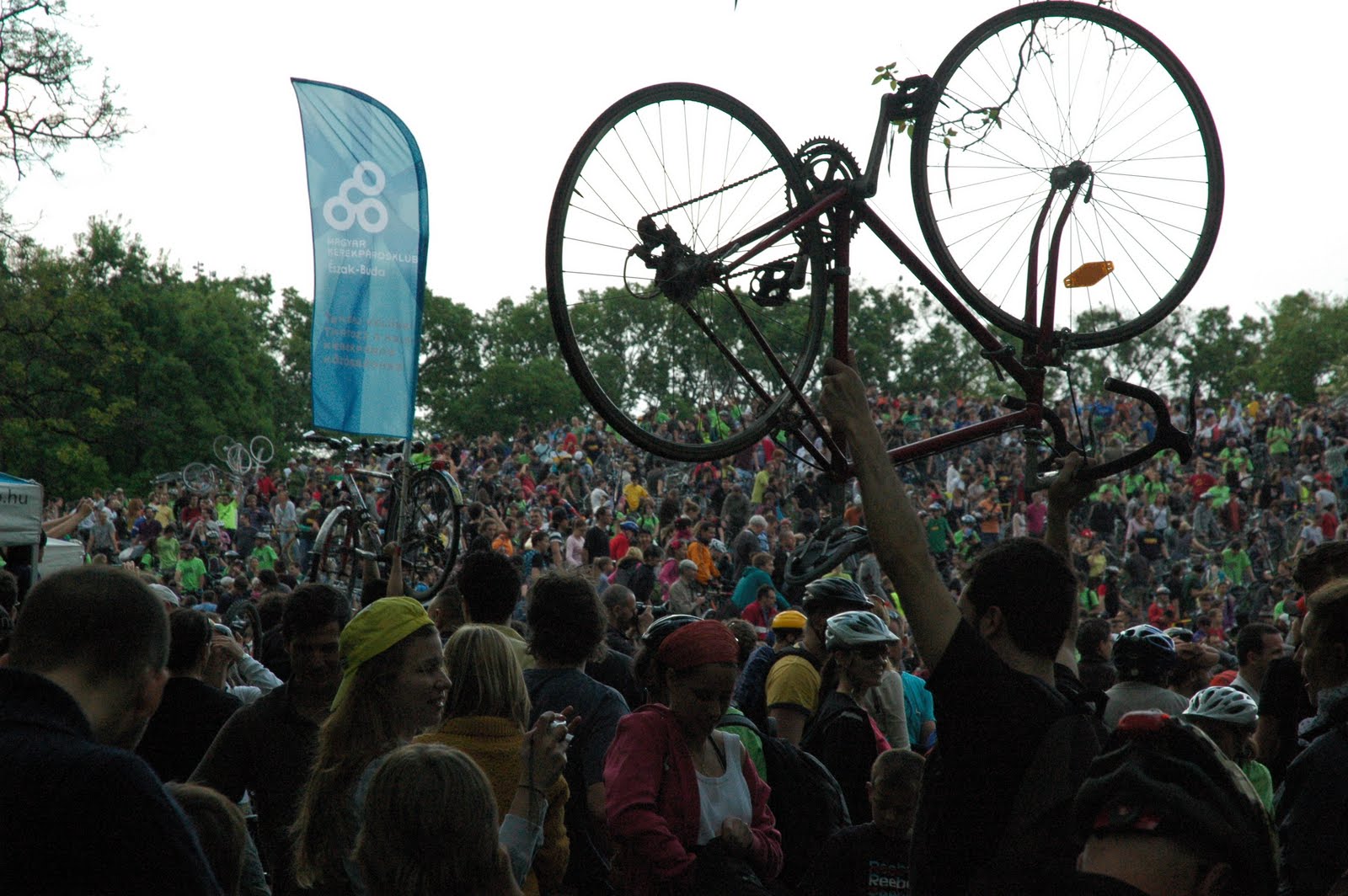
The demonstration, dubbed "Happy Mass," will happen Tuesday, May 24. Participants are asked to come down to Károly körút and mass on both sides of the Madach tér crosswalk between 5:45 and 6 p.m. You're supposed to line up along with bike paths along the sidewalks, and then at 6 p.m. there will be a traditional bike lift. After that, for 45 minutes cyclists will ride up and down the new bike paths, with no explicit instructions on how and when to turn and cross the street to double back the other way. The idea is just to occupy the path for awhile, much as last fall's Critical Mass was about occupying the nagykörút.

At 6:45 p.m. Hajtas Pajtas head Gábor Kürti will lead a public discussion about the path and cycling matters in the small auditorium of the Merlin Theatre.

Saturday, April 30, 2011

First of the last

Had another pleasant Critical Mass ride Saturday afternoon. Despite some scary looking skies and a couple lightning strikes up in the Buda Hills, we had only a few minutes of rain, and by the time we got to the ride's end in City Park, the sun was blazing.

The Hungarian state wire service MTI put participation at 20,000-30,000, which is par for the course for the last three years. The MTI report stated further that no accidents or other disruptions took place.

On this occasion, I was joined by Kristin and our almost year-old daughter Sequoia (Her older brother was indisposed with a birthday party -- I suppose the same will happen with Sequoia when she's old enough to decide these things for herself). Most of the ride, you could barely see her under her helmet, which despite having been the smallest at the store, is several sizes too big. Whenever she goes out with us she starts sucking her thumb and disappears like a Mexican peasant under a sombrero.

The ride route passed by a couple street-work projects on the Pest side. The first was a new bike path that's part of an attractive, EU-subsidised renovation of Marcius 15 ter on the Danube bank. Typical of Budapest, the path doesn't appear to link up to anything on either end. That's because, at least for the last seven years or so, cycling infrastructure is never built for its own sake, but only as an add-on of another project.

The other road works was the rapidly progressing renovation of the kiskörút between Astoria and Deák tér. When it's finished, it's supposed to include bike lanes on both sides of the street. The work hasn't advanced enough to show how this will look but it's getting close.

The ride concluded at City Park, but this year, instead of being on the flat field behind the Petöfi csarnok concert hall, we were across the street on a little hill called Királydomb. At 25-30 metres, it's not much of a hill, but it afforded a good view of scene.
One thing I could NOT SEE was a beer vendor. There were plenty of stands selling those fluffy, soft pretzels that seem to be a Hungarian specialty. But no one had beer. Last spring, all the vendors had cold beers and there were also a bunch of guys roaming through the crowd with insulated backpacks full of beer.

I suspect that the heavily advertised police crackdown on cyclist mischief had something to do with it. Actually, I noticed that many participants had tins of beer in their hands (see above, behind Kristin and Sequoia) but it may have been because they were better planners than me and brought their own. Note to self: Plan better for next Critical Mass.
If there is a next Critical Mass. This spring's event was billed "the first last Critical Mass." It's hard to know what that means, if anything. But I'm very curious what will happen in September, when the year's second Critical Mass is traditionally scheduled.