Friday, May 20, 2011

Bike sharing for Albania

In the field of bike sharing, Budapest has been beaten to the punch by an unlikely rival: Tirana, Albania.

Although Tirana is capital to one of the poorest countries in Europe and doesn't have near the cycling levels as Budapest, a local NGO found the courage to launch an impressive, low-tech bike sharing system in the downtown area.

Dubbed Ecovolis (Albanian for "Ecobike"), the system launched March 23 with four stations with 10 bikes each. They've already sold 2,000 subscriptions and have rented bikes out to many more customers on a per-trip basis.

The public enthusiasm has exceeded the best expectations of the group behind the scheme: the Social Alternatives Incentive Programme (PASS). It's also stirred interest among potential corporate donors, who had earlier raised their eyebrows at the idea. “Before starting the project, it was very difficult for us to persuade companies to sponsor the project,” said PASS's communications manager Jola Foto. “Now the companies are interested and trying to negotiate with us to sponsor the project.”

The response has been so promising, PASS already plans to open an additional two stations in Tirana and even hopes to expand Ecovolis to neighbouring communities.

Although the system is admittedly small for a city of 600,000 people, Ecovolis has been a feat of ingenuity and perseverance given the circumstances. In terms of infrastructure, Tirana has only a few recreational paths on the margins of city green areas, and also a few experimental shared bus/bike lanes. There is simply no culture of transport cycling in the city, and the modal share -- if it were to be measured -- is assumed to be well under 1 percent.

In a sense, introducing bike sharing to Tirana is tantamount to introducing cycling to Tirana. Full stop. Organisers had to be realistic about the start-up budget, while at the same time, make a big splash and stimulate interest in a novel transport concept. And because PASS's core mission is creating opportunities for needy citizens, they wanted the programme to have a strong social element.

So PASS rolled out Ecovolis as one element of a broader programme called Tirana Community Bicycle. Part of its activities are giving away bicycles to children of needy families and part is offering necessary staff positions to marginalised citizens. The programme also includes Sunday cycling lessons and various cycling activities for youth.

In regard to the bike-sharing scheme, it had to be low-tech. A swipe-card activated system of the type operating in London, Paris, Barcelona (and soon in Budapest) would have been far too expensive for Tirana. And aside from the cost, swipe cards just aren't used much in Albania.

But this was fine. PASS fashioned Ecovolis as a social business: Each docking station is staffed by two attendants at all times. The necessary staffing not only creates jobs (two shifts per day = four jobs per station), it also puts a human face on the service. The attendants can explain and promote bike sharing while raising awareness of utility cycling in a brand-new market.

Key to getting the project off the ground was the support of Tirana City Hall and a cash donation of USD 24,000 from the George Soros-funded Open Society Foundation Albania (OSFA). Even more significant was a donation of 450 used bikes from the US-based Pedal for Progress organisation.

One difficulty has been the higher than expected maintenance needs. Although this is a typical challenge for bike-sharing systems, it may be hitting Ecovolis especially hard due to the inexperience of users and the somewhat delicate quality of the standard-issue bicycles. During the initial weeks of the project, 30 of the scheme’s 40 bicycles required repairs on any given day. PASS hopes to address this by purchasing sturdier, new bikes as the system is expanded. It was also hoped that as the scheme’s customers get used to the system, they'll learn to use the bikes without causing damages.

Despite teething problems, Ecovolis is moving ahead. Plans include creating a database of users and members to get a better handle on Ecovolis's market (half of subscribers are women) and to start giving service discounts to Ecovolis customers. Meanwhile, according to Foto, PASS is in talks with the mayors of Durres, Pogradec and Vlora for possible franchises.

Thursday, May 19, 2011

Happy Days


Not even a month has passed since the "last" Critical Mass, and they've already announced the reunion tour.

To be fair, the occasion isn't a proper Critical Mass, but rather a one-off celebration of a welcome addition to Budapest's cycling network: the new bi-directional bike lanes on the kiskörút (Little Ring Road). The whole reconfiguration of this busy thoroughfare looks to be a big improvement for downtown, and the bike lanes -- one on each side of the street next to the curbs -- were included in the plans thanks to vigorous lobbying by the local cycling movement.

Now there are bike lanes on both sides of the kiskörút running from the Szabadság Bridge all the way to Déak tér. I can't recall exactly how much car parking this path has displaced, but it's quite a few spaces, and that fact alone makes this bit of infrastructure ground-breaking by Budapest standards.

Compare that to the bike path that runs north from there down Bajcsy-Zsilinszky to Alkotmány utca. It's on one side of the street only, making it inconvenient for northbound travellers. And the designers, rather than taking away a centimetre of space from this rather capacious urban motorway, decided instead to run it down the the sidewalk -- taking space from pedestrians. It was a wasted opportunity for sustainable mobility, but hopefully, the more enlightened approach on the kiskörút will set an example that future traffic planners will follow.

Now that the kiskörút paths have actually been completed -- and in a fashion conforming to the promised design -- the guys at Hajtas Pajtas bike couriers want to celebrate and give due credit to the city leaders, planners and contractors who brought it to fruition.

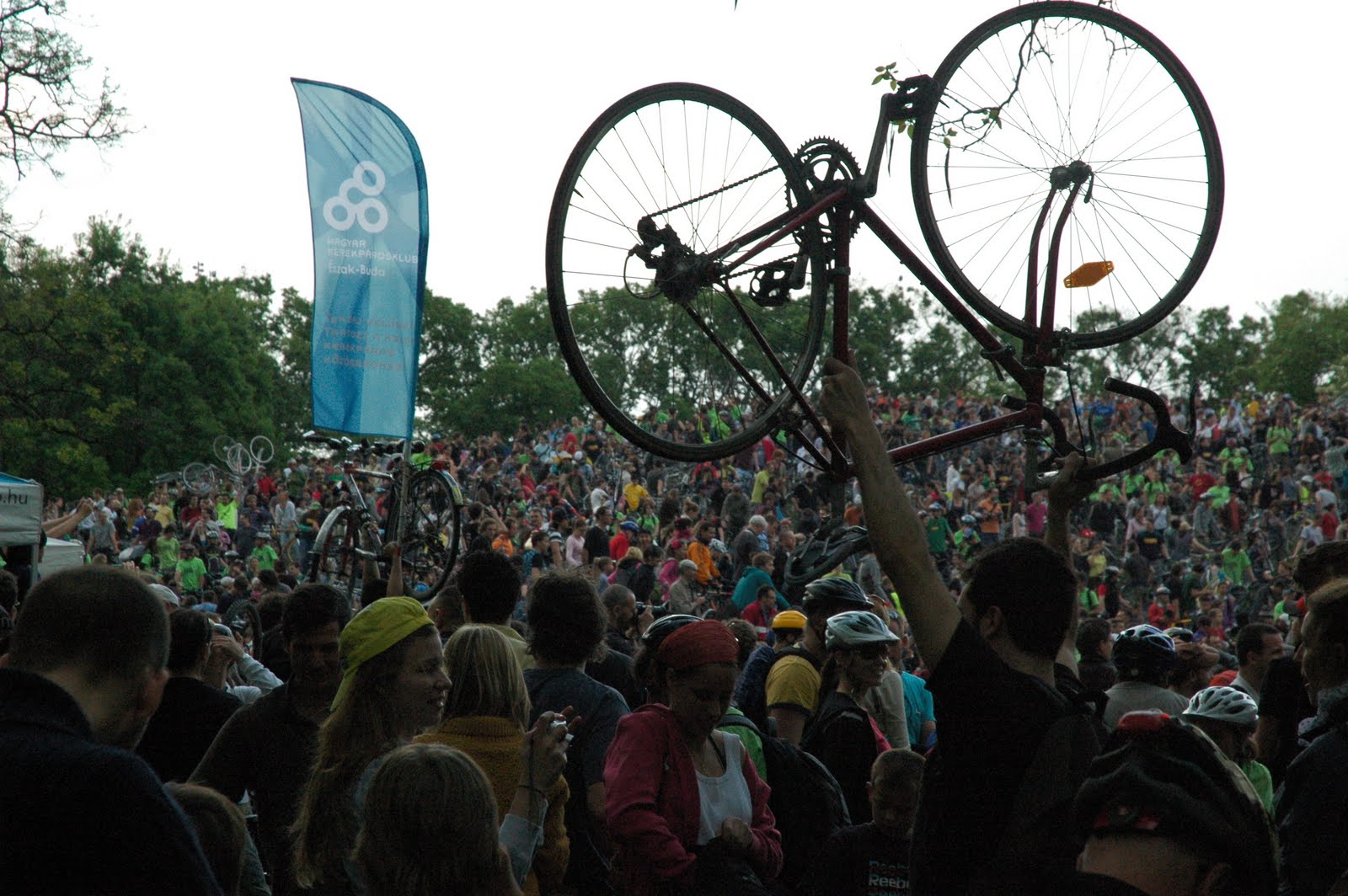
The demonstration, dubbed "Happy Mass," will happen Tuesday, May 24. Participants are asked to come down to Károly körút and mass on both sides of the Madach tér crosswalk between 5:45 and 6 p.m. You're supposed to line up along with bike paths along the sidewalks, and then at 6 p.m. there will be a traditional bike lift. After that, for 45 minutes cyclists will ride up and down the new bike paths, with no explicit instructions on how and when to turn and cross the street to double back the other way. The idea is just to occupy the path for awhile, much as last fall's Critical Mass was about occupying the nagykörút.

At 6:45 p.m. Hajtas Pajtas head Gábor Kürti will lead a public discussion about the path and cycling matters in the small auditorium of the Merlin Theatre.

Saturday, April 30, 2011

First of the last

Had another pleasant Critical Mass ride Saturday afternoon. Despite some scary looking skies and a couple lightning strikes up in the Buda Hills, we had only a few minutes of rain, and by the time we got to the ride's end in City Park, the sun was blazing.

The Hungarian state wire service MTI put participation at 20,000-30,000, which is par for the course for the last three years. The MTI report stated further that no accidents or other disruptions took place.

On this occasion, I was joined by Kristin and our almost year-old daughter Sequoia (Her older brother was indisposed with a birthday party -- I suppose the same will happen with Sequoia when she's old enough to decide these things for herself). Most of the ride, you could barely see her under her helmet, which despite having been the smallest at the store, is several sizes too big. Whenever she goes out with us she starts sucking her thumb and disappears like a Mexican peasant under a sombrero.

The ride route passed by a couple street-work projects on the Pest side. The first was a new bike path that's part of an attractive, EU-subsidised renovation of Marcius 15 ter on the Danube bank. Typical of Budapest, the path doesn't appear to link up to anything on either end. That's because, at least for the last seven years or so, cycling infrastructure is never built for its own sake, but only as an add-on of another project.

The other road works was the rapidly progressing renovation of the kiskörút between Astoria and Deák tér. When it's finished, it's supposed to include bike lanes on both sides of the street. The work hasn't advanced enough to show how this will look but it's getting close.

The ride concluded at City Park, but this year, instead of being on the flat field behind the Petöfi csarnok concert hall, we were across the street on a little hill called Királydomb. At 25-30 metres, it's not much of a hill, but it afforded a good view of scene.
One thing I could NOT SEE was a beer vendor. There were plenty of stands selling those fluffy, soft pretzels that seem to be a Hungarian specialty. But no one had beer. Last spring, all the vendors had cold beers and there were also a bunch of guys roaming through the crowd with insulated backpacks full of beer.

I suspect that the heavily advertised police crackdown on cyclist mischief had something to do with it. Actually, I noticed that many participants had tins of beer in their hands (see above, behind Kristin and Sequoia) but it may have been because they were better planners than me and brought their own. Note to self: Plan better for next Critical Mass.
If there is a next Critical Mass. This spring's event was billed "the first last Critical Mass." It's hard to know what that means, if anything. But I'm very curious what will happen in September, when the year's second Critical Mass is traditionally scheduled.

Friday, April 22, 2011

King of the Hill

Spring is a time of new beginnings, and for our 6-year-old boy Lance, this meant a major rite of passage: last month, for the first time, he rode his own bike to school.

In other circumstances, he might have done this even earlier. But a couple local challenges made this trip practically unthinkable until this spring. And it wasn't until he actually did it did I believe it was even possible.

The first challenge is Budapest's traffic, and the lack safe, separate infrastructure for cyclists. At our flat near Margit Bridge on the Buda side, we're pretty well hemmed in by major urban thoroughfares where cars race around at high speed. As Lance has become more stable on his bike, I've let him ride on sidewalks and on the riverbank promenade (Duna Korzó). But it's nerve-wracking accompanying him on these trips and that's one reason I hesitated about letting him bike to school.

The other reason is that his kindergarten is up a big hill from our flat. That climb is an exertion for me, even in low gear on my 21-speed hybrid. With Lance's last bike, a short-cranked, 16-inch one speed, anything more than a wheelchair ramp was about impossible without getting off and pushing.

But this spring, he traded up for a 20" bike with seven gears. From the moment he got the bike, he was nagging me to let him ride it to school. One thing I wanted him to figure out first, though, was how to use gears.

Gears are not an intuitive concept, apparently. I've had difficulty explaining what they're for without resorting to terms like "torque." To keep it simple, I told him that high gear is for going fast, and low gear for going slow. Naturally, he wanted to ALWAYS be in top gear so he could go fast. Delving deeper into six-year-old psychology, I told him that low gear is good for accelerating, for taking off and reaching a high speed -- like a drag racer. This better describes the physical principle behind gears, but it backfired as a layman's explanation. Now Lance wanted to ALWAYS be in low gear. He seemed to like the exhilaration of peddling really fast -- it made him feel like he was GOING fast.

At any rate, a couple weeks ago, I agreed to let him bike to school, with me accompanying, naturally. I had to nag at him a bit to get him to downshift before we hit the hill but he finally relented. We scooted across the Torok utca, and started up the serpentining street that winds up the flank of Rozsadomb. Lance tore up the hill and he kept going for the whole climb, putting his foot down only where we had to jump curbs.

We've biked almost everyday since then and I reckon within a couple years, he'll be ready to take his first solo trip. It'd be nice if he had a separate bike path by then, but in any case, the trial by fire of Budapest's streets will get him prepared for whatever happens.

Tuesday, April 19, 2011

Breakfast of Champions


During the Hungary Bike-to-Work campaign (Bringázz a munkaba), there are always a couple of occasions when the organisers have a bikers' breakfast promotion. They set up stands along major bike routes all over the country and treat passers-by to free sweet rolls and juice.

They had one on Tuesday morning and I wanted to take my boy Lance down to get a sweet roll. We went down to the station closest to our flat, collected our goodies, and I snapped this picture of Lance with his new bike and our breakfast in the background. Can you believe that in the five-second interval between us setting down the food and me framing the shot, a frickin' pigeon jumps up on the railing and attempts a snatch and run on Lance's kifli?!

From all appearances, the breakfast "action" seems to be a case if preaching to the converted. At least at the station we visited, along the Buda quay by Batthyány tér, there was a regular stream of cyclists going by. And this was regular traffic -- not people lured by free food. The girls doling out the sweet rolls did their best to flag everyone down, but the majority were rushing off to work and couldn't be bothered. From this spectacle, it was abundantly clear that Budapest is already a real cycling city.

The breakfasts are, however, a great photo op and press availability. A significant part of the breakfast crowd at Batthyány tér were photographers and reporters looking for a little "colour" for their media. The shot above shows Hungarian Cyclists' Club President János Laszló doing what he always does: trying to edify the masses about the value of cycling as urban transport. Sometimes it seems that guy is everywhere.

Friendly Chat with Mr. Dickhead

Had a Bruce Banner moment yesterday on my ride home. It wasn't entirely the motorist's fault, although he was definitely being a big asshole. But it's also true that I came to the scene in somewhat of a funk. A couple hours before, my wife had phoned to tell me that some lowlife had busted into our building's storage shed and stolen my son's new bicycle. What kind of vermin steals a little kid's prized possession? It made me so mad I wanted to rip someone's head off.

So when this cookie cutter suit in a white BMW/Mercedes/Audi (Why do people pay such exceptional sums for things that are so patently unexceptional??) plants his ass smack in the middle of the crosswalk while WE got the green -- well, he seemed like the perfect stand-in for the jerk who stole Lance's bike.

As I followed the serpentining queue of walkers and cyclists in between the cars and around the butt end of the asshole's coupé, I gave his rear window a good thump with my fist and sneered provocatively around my shoulder as I got through the intersection. I fumed and cussed as I pedaled along the bikepath next to the road, and who should appear again for a little point-counterpoint, but Dickhead úr, pulling up to the kerb and shouting through the passenger window to find out why I had pounded on his BMW/Mercedes/Audi.

I threw down my bike and invited him to get out of his car so we could discuss it. But he kept in his coupé (or should I say chicken coupé) and kept shouting. I was just in a rage. I think I'd just primed myself for a punch up, and now I was reduced to trying to make an argument about the Hungarian traffic code with some guy who obviously didn't care. Anyway, trying to argue in Hungarian was beyond hopeless. I couldn't speak straight in my own tongue.

Anyone who can't grasp why these things make me so mad is as brainwashed by car-culture norms as Dickhead úr. I look at it from the point of view of space allocation. The scene was along Arpad fejdelem utja, just north of Margit Bridge. Here cars have six wide lanes plus a big median for turning. Pedestrians and cyclists have one sidewalk and, in certain sections, a skinny bike path to boot. You could state that cars have, conservatively, seven times as much space as either pedestrians or cyclists.

And here's a motorist telling me the reason he was on the crosswalk when pedestrians and cyclists had the right of way was because, "I had nowhere to go."

The way he reasoned it, it was bumper-to-bumper traffic and he simply could not get through the intersection. Of course, by law, if it's bumper-to-bumper traffic and you can't get through an intersection, then you shouldn' t enter the intersection in the first place. The proper thing to do is wait behind the stop line until there's sufficient room to get all the way through.

I didn't have the patience or clarity of mind to explain this to Dickhead úr. I hope I succeeded in insinuating it by giving his car window another hard wallop as he burnt rubber to leave me -- and get out of the bus lane he was blocking.

Tuesday, April 12, 2011

Temporary Deathtrap. Thank You for your Understanding.

Spring's springing and although that means more pleasant temperatures for cycling, it also heralds another season of road work. A recent post at copenhagenize.com tells how in the Danish capital, the temporary traffic restrictions associated with street projects are de facto bigger hassles for motorists than they are for cyclists or pedestrians. In that city, human-powered transport gets priority over the loud, smelly variety. In fact, it's against the law to shut down a bicycle lane.

I couldn't help but think of the Margit Bridge renovation, underway since August 2009 and several months past schedule. The work on the Buda bridgehead shut down the north-south cycle passage through the underpass by the BKV ticket window at the HÉV stop. I remember how I learned the passage was closed. One day, I biked into the underpass and by the ticket window and then came to a big black wall. There were no signs advising me where to go, no detour. The work crew hadn't considered cyclists. Or if they had, the conclusion was apparently that we could go fuck ourselves.

By now, the regular bike commuters who pass by here know the score. With no designated bikeway, they ride in fast-moving traffic through a bottleneck under Margit bridge. I went out this evening to take some snaps of the brave souls riding through here, elbow to fender with motorists who are probably as nervous about killing cyclists as the cyclists are about being killed.

I wish the mayor, or transport department head, or whichever no-account politician is responsible for this deathtrap, would try cycling through here with their children. I did this one time and nearly had a heart attack trying to keep my boy to the right and out of harm's way. Never again. We take long detours to avoid it.