With all that open road, I couldn't stick to the speed limit.
As the Danube continues to rise, the low roads along the banks are flooding and being closed to motor traffic. On alternative routes, traffic chaos ensues, giving morning migraines to thousands of car-bound commuters.
For cyclists, though, the flood's not been a problem. In fact, yesterday on the Buda quay, the flood made bike commuting even faster. I hate to gloat in front of my four-wheeled friends, but when I hit the freshly closed embankment north of Margit híd, I FLEW!!
Reminded me of those magic months a few years ago when the embankment was closed for a sewerage project. People were out on running, skating, pushing strollers and riding bikes, with an abundance of space rarely seen outside of Wyoming.
After rocketing non-stop all the way to the Graphisoft Park, I downshifted to subsonic speed and slalomed through the police road blocks along Királyok útja / Nánási út. (With the exception of one cop who told me I should ride on the sidewalk (according to Hungarian traffic rules, this is actually illegal unless you're under age 12), police basically turned a blind eye to cyclists. This has been a very easy way to get around.
The fearsome Hungarian rendôrség takes charge near Római part.
***
I rode along Eurovelo 6 route on the riverside for a ways, then through strawberry fields around Budakalász. Finally got up to Szentendre, which is putting its brand-new mobile dike through the paces. If you're curious about what the powers that be have in mind for Római part, this is a good reference. The difference, of course, is that in Szentendre, the mobile dike is merely replacing a section of a conventional earthen dike that has been there for decades. In Római part, they'll have to build it up from scratch, which will mean a drastic transformation of the river bank.
Traffic jam on the Buda embankment
At a low point between Szépvölgyi utca and Tímár utca, the water was already over the road, so had to jump up onto the bike path.
Skaters on the embankment -- what's the world coming to??
At this point, the Eurovelo signage was leading me astray.
This road through Budakalász is restricted to local motor traffic -- but transiting cyclists are no problem.
A U-pick (szedd magad) strawberry field near Budakalász.
Atop the old dike in Szentendre, and looking at the new mobile dike around the bend.
Southern end of the Szentendre mobile dike.
At the north end of the Szentendre dike, it's a simple concrete wall. Workers are doing finishing touches with cut-stone facing.
The Danube's flooding in Budapest again, and as the water was rising, I rode down to Romai part yesterday afternoon to see the preparations.
Every buffet and restaurant was closed and everything that wasn't anchored down had been moved to higher ground. The water had already covered parts of the bike path, making it impossible to ride the whole length of the embankment without taking inland detours.
Many of the property owners down here, including the boat houses and the concession stands, will just let their properties get flooded. Some of the homes, though, are surrounded by big barricades and they were fortifying these with sandbags in hopes of keeping dry.
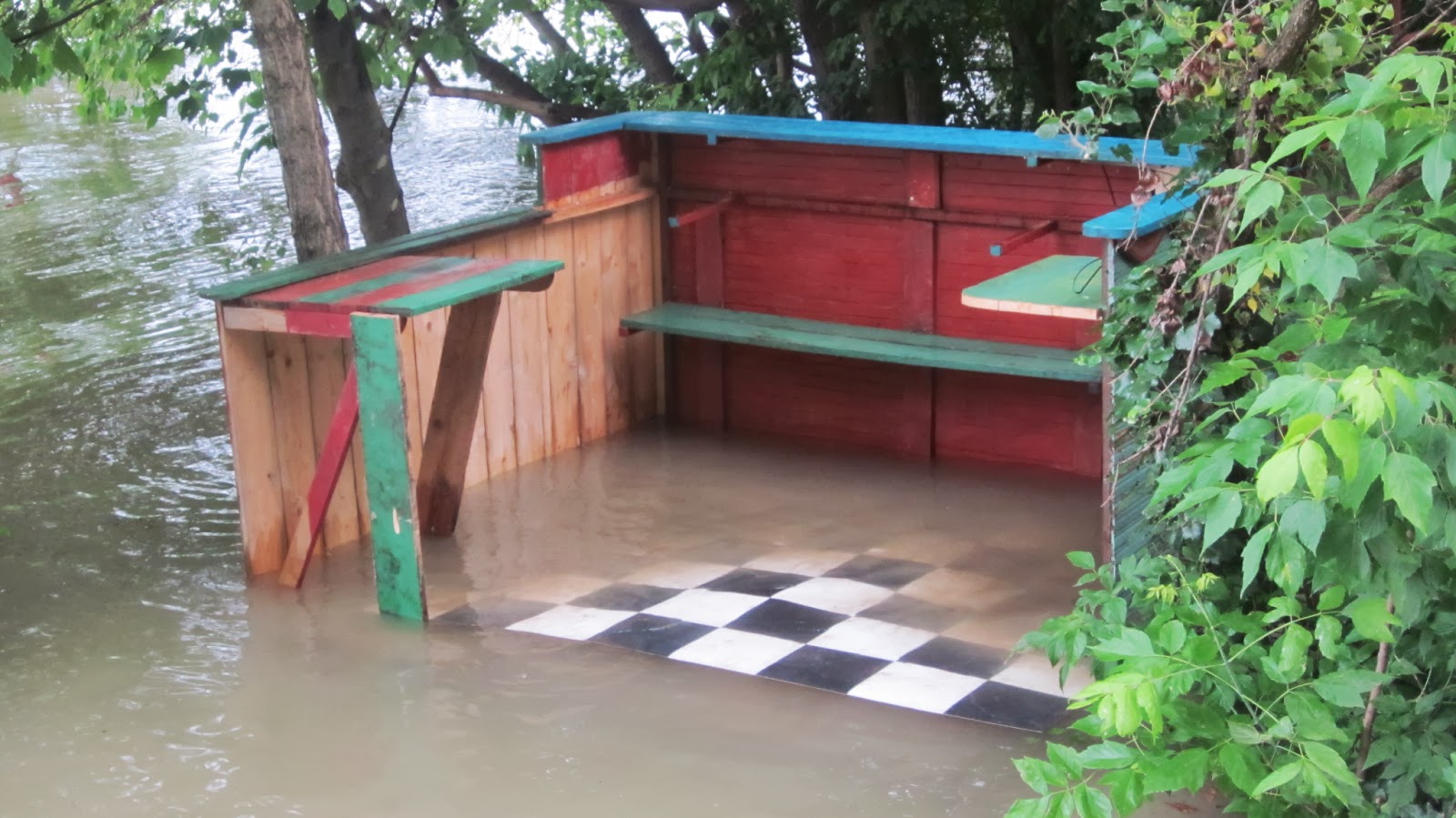
The lowest-lying bierstube along here, Fellini bisztro, consists of a repurposed diner car and a bunch of beach furniture. It had all been trucked away by the time I arrived Tuesday around 6 p.m.
Public controversy has erupted over a plan to create a mobile dike along this section of Romai part. It would involve bulldozing earth some 50 metres into the river and cutting down scores willow and cottonwood trees along a bank that's popular precisely because of its natural state. Along with boat houses and beer stands, people come to Romai part for recreational rides on the Eurovelo 6 international bike route.
The dike proposal is driven by the owners of some newer developments that displaced old, flood-friendly boat houses. They shouldn't have been granted building permits, but they were, and now they have the support of the Budapest Municipality for a HUF 4 billion flood protection project to protect their properties.
These plans are now awaiting technical approvals from river protection authorities. If the level of this flood exceeds the height of the planned new bulwark, it will be proven a vain effort. The river level is expected to to crest over the weekend. We'll see what happens.
Protecting some private houses. This wall runs intermittently along the inland side of the bike path. Protesters against the proposed Romai part "mobile dike" have promoted an alternative plan that would involve strengthening and filling in the missing gaps of this wall.
The entrance to Matyas Kiraly ut will be closed to seal this gap in the existing flood wall.
Water rising at a boat house launching dock.
This bike rack was one of the few things not taken away in the evalcuation of the Fellini bisztro.
Same place as above, circa July 2011, during dryer times.
Part of the Fellini's kitchen also stayed behind.
This section of the Romai part bike path was already impassable Tuesday.
Closed due to flooding.
To the right, one of the new flood-averse developments on the Romai part.
The south end of the Romai part bike path is closed til further notice.
Poppies, May 29, about a kilometre north of Budakalasz on the bike path next to Route 11.
Sometimes in this crazy, herky-jerky world of ours, you need to -- as the old folk wisdom goes -- stop and make a jpeg of the flowers. That's what I did on yesterday's morning commute to Szentendre.
I first came across this sight last Thursday. It seemed like practically overnight the grassy overgrowth lining the bike path north of Budakalasz had burst into colour.
Sideview
Apparently from Papaver somniferum's point of view, this spring has provided an optimal balance of warm sunny days and cool rainy ones. I'd never seen so many poppies with such huge blooms. When I first noticed the spectacle last week, I didn't have my camera. I made a note to bring it on my next commute, although I didn't have big hopes of catching them again. It was just before the weekend, and the durations of these phases of spring splendour seem to be in inverse proportion to their beauty. However, when I returned with camera in hand, the scene was not diminished. Just as gorgeous as before.
Taken with a Canon PowerShot SD1300 IS (nothing fancy, but sometimes makes a nice shot).
I tried to make a video to give an impression of the experience of riding through the long allée of blooms. Unfortunately, my little Canon point-and-shoot did not produce Hollywood results. The path is riven with cracks and holes, and my one-hand-on-the-handle-bars-one-hand-holding-the-camera technique didn't help. But I've included the video here anyway.
The stills came out well, and they give their own sort of visual pleasure. But I reckon no digital facsimile can match the real-life experience of riding your bike through a field of poppies in full bloom. It's a real treat and -- now for the inevitable editorial -- not something you're going to get commuting by car.
When Sequoia heard Budapest was ranked the no. 13 cycling city in the world, she just laughed.
Budapest ranked no. 13 in the recently published Copenhagenize Index of best cycling cities in the world. This year the index covers an expanded list of 150 cities.
My first reaction at seeing this? You've got to be kidding! Budapest, Hungary?! Where I was nearly decapitated by a hedge after riding into a pothole the size of Kim Kardashian's butt? Where they won't allow cyclists on the main streets in the city because there's no room?? Where the name of the much anticipated public bike system is a homonym for the mildly vulgar English term for a woman's breast??
Who are the idiots who make these listings, anyway?
Then I remembered it was me. Or at least partly me. The Copenhagenize Index is a sort-of "group-source" thing relying on some 400 local yokels who do self-evaluations of their own cities. They don't compare and contrast cities, but just rate their own scene, albeit according to standardized criteria given by Copenhagenize. Each city is supposed to be evaluated by multiple volunteers, so there's some triangulation. You can look over the index questions and methodology yourself.
Although memory doesn't serve as well as it used to, I don't think I gushed about Budapest in my own evaluation. I remember being generally critical. But I may have let some local pride skew my score upward. Or maybe it was another Budapest local who exaggerated the city's virtues.
In any case, no. 13 in the world seems like an AWFULLY high rating for Budapest. That puts us one step ahead of Paris, which back in 2005, I proposed as a good model for Budapest. Have the tables turned since then? I don't believe they have. Velib has been expanding since its launch in 2007, while Bubi is already two years past the originally announced roll out. Meanwhile, the Paris Respire and Plage schemes, where streets are closed to motor traffic every weekend of the summer, help promote active transport and better quality of life. Budapest has had only occasional one-off street closures -- usually on European Mobility Week.
Or take London, which didn't even crack the Index's top 20. I was in London last fall, and tried out the Boris Bikes and Barclay's Cycle Superhighways -- impressive investments that had been implemented in the previous couple years. Budapest cycling investment during the same period paled by comparison.
Of course, Budapest does have its good points. They're pretty much the same now as they were in 2011, when Budapest was ranked no.11 in the Copenhagenize Index. No other city beats Budapest Critical Mass. And largely because of the local CM, there is today a large, enthusiastic population of citizen cyclists who are out braving Budapest traffic everyday despite potholes the size of Kim Kardashian's butt. As the Index explains, "Budapest is a regional leader in bicycle culture but without political
will and a modern desire for mobility change, their role will be
overtaken by others." Amen to that!
A couple days after the record-setting Critical Mass last weekend, some friends were debating whether it would make any real difference. Steve, always the skeptic, speculated that if there are any cycling investments at all, they'll be in remote districts where no one will use them. Gábor, who's volunteered for CM for several years, countered that improvements HAVE been made in recent days, including an important one smack dab in the middle of the city.
Gábor was right: In downtown Pest, new priority bike-bus lanes have opened on Bajcsy-Zsilinszky út. These follow the city policy adopted last summer of allowing cyclists to share priority bus lanes on important city arterials. Previously, cyclists were officially banned from bus lanes, which was a sort-of policy contradiction -- on all other streets (barring those with dedicated cycling lanes), cyclists are required to stay in the lane closest to the curb.
Of course, the opening of the bus lanes to cyclists is really just a matter of new paint. But in Bajcsy's case, it has involved more paint than usual. The lanes are marked every 20 or 30 metres with big red boxes emblazoned with the word "bus" and an icon of a bike. It makes for a very clear signal that the traffic regime has changed in favour of cyclists. In similar lanes in Budapest, the only indication that bikes are welcome is an occasional yellow icon.
Perhaps one of the reasons for the lavish deployment of paint is the history of political conflict over Bajcsy. About 10 years ago, when the city was preparing to resurface it, the cycling lobby was invited to propose solutions for cycling accommodation. The cyclists said they wanted bike lanes on both sides of the road -- following good western examples. Typically, the city countered that there was no room (a joke considering Bajcsy is one of the widest streets in the city). Cyclists were offered a narrow, two-way path on the western sidewalk. Cyclists were loathe to accept this because it would take space from pedestrians. But ultimately, they decided that something was better than nothing, and that with thoughtful execution, they might mitigate cyclist-pedestrian conflicts. And on the positive side, they reasoned, a sidewalk-based path might induce a few car-fearing people to join the ranks of Budapest cyclists.
In the event, the path was very clearly marked and separated from walking space -- more so than on any other sidewalk bike path in Budapest (compare it with the half-hearted efforts at separation on the Buda korzó, for instance). Critical Mass honcho Gábor Kürti has been apologising for the deal with the devil ever since, but it has to be admitted that the Bajcsy path has been very well used and probably did serve as a useful stepping stone in the evolution of Budapest's cycling infrastructure.
I've been up and down the new lanes a couple times by now, and they are certainly a step forward. Now, if you're going south-to-north on the bike lane on the kiskörút, you can go straight through the intersection with Andrássy út without having to stop and get over to the sidewalk path. And if you're heading toward the river on Andrássy, you can turn right on Bajcsy and continue as a motorist would.
It's easier but still not ideal. Sharing lanes with buses -- and taxis, as well -- is not for the faint-hearted. As on all Budapest thoroughfares, motor traffic is fast moving and aggressive and on a bike you feel exposed. These lanes are a rung up on the evolutionary ladder, but there's a way to go yet. A next step could be grade-separated cycle tracks to get cyclists out of harm's way. Beyond that, traffic could be calmed, sidewalk space enlarged and tramlines extended through from the other side of Andrássy. This won't happen overnight, but Bajcsy's current incarnation as a private-car motorway is looking more and more like an anachronism.
What a gratifying close to Budapest's nine-year run of Critical Mass rides! Saturday's was announced as the last Critical Mass, and everyone was urged to come out and give it a grand finale. The goal was to make it the biggest one ever. I have to admit I was skeptical, knowing that participation had dropped off by half since the record setting ride of 2008. I was proven wrong. The sea of people at the closing bike lift behind Petöfi Csarnok was bigger than any I'd ever seen it. Cyclists took up the entire meadow behind the csarnok, and the spillover on the other side of Zichy Milhály út may have been as big as the crowd in the meadow.
As always, it's impossible to get a convincing head count. But organiser Gábor Kürti told the kerékagy blog that if the spring 2008 record had been 80,000, the turnout Saturday was surely 100,000. He confessed, though, that he didn't witness the closing bike lifts because he'd broken down in tears. Reading that Kuku cried made me cry. What a great story!
My own ride got started about half an hour behind schedule, because our girl, Sequoia decided to go down for her afternoon nap right before the scheduled start at 3:55 p.m. I put on her shoes as she laid there snoozing, and she was still half dozing as I carried her down to my bike in the courtyard.
Start of Critical Mass, Kristin, me and Sequoia and Gabor's daughter Anna in background with head framed by bike sign.
Luckily, the starting point was just right across Margit híd from us, so when we arrived on the Pest side at half past 4, the procession was still just starting. I met up with Critical Mass activist Gábor Bihari and his daughter Anna just south of the bridge on the bike path. We sat there chatting for another half hour as the very long queue of cyclists on the quay crawled down toward Parliament and then just got stuck for awhile due to some downstream obstruction.
We were still sitting there when my wife, Kristin, joined us after dropping our boy off at a friend's. We couldn't even get down to the quay from the bike path because escorts blocked our way. If they'd let people cut in, the procession would never have moved. I guess it was past 5 when the whole procession had advanced far enough, and we were able to join it on the tail end. We hooked up with friend Steve Graning and his two girls, Sara and Melina (the latter on a scooter cause her bike had been polished up for resale).
We were at the very end of a kilometres-long line and being shepherded by green-shirted escorts on bikes, an ambulance (sweeping up the hundreds of dead and injured -- just kidding!!) and some crabby cops in a squad car. The cops yelled at us to move it along, apparently anxious to reopen the roads to motor traffic as quickly as possible.
We ran into a friend Péter Dalos, who was on a two-wheeled cargo bike with two children, a huge bag full of laundry, and the kids' two little bikes. I'd seen him with the same enormous load just three days earlier and I was too embarrassed to ask him if he'd been evicted from his home. I'm sure there's another explanation -- the whole family seemed very enthused and were wearing clean clothes.
Sequoia needed a pancake break on the final stretch down Andrássy út.
Of course, every bar that we passed had a crowd of cyclists loitering outside with tins of beer in their hands. Cycling while intoxicated is illegal, but this rule is openly flouted by thousands of participants at Critical Mass. I guess the idea is, if enough people drink, it's just impossible to enforce. A prime example of civil disobedience as a force for good! I kept asking Kristin if we could stop and join the fun and she kept on resisting, saying I shouldn't drink and ride with our daughter on board (she had me in a corner there). Then we passed by a wine bar (the Bor Tarsaság near the Buda side of the Chain Bridge) and then the shoe was on the other foot!
By the time we got across the Chain Bridge, the weather was turning and it looked like the predicted rains would soak us afterall. But the blackening skies and gusts of wind were all bark and no bite. I felt a couple drops of rain, or imagined I did, but it turned out to be one of those classic Earth Day Critical Masses whose huge turnouts had the blessing of Mother Nature.
It was pretty loud at the closing bike lift.
Sequoia was a real trooper, too. Didn't pout once and was generally amused by the whole thing. At the end, a nice young man who'd picked up a blue Cyclists Club balloon gave it to Sequoia, and that kept her happy all the way home.
These guys used a bus stop as a band shell and gave us a serenade as we were leaving City Park following the bike lift.
The weather's been brilliant this week -- the first real spring weather this season. But it was a long, long time in the coming. Hungary had more precipitation in the first quarter of 2013 than it's had since 1911. The last snow fell just a couple weeks ago. So when the sun came out this week, people started biking like they might not get another chance. And who knows if they will? We've had summers in recent years that never really materialised.
Anyway, this was the scene Thursday morning on the Buda korzó bike path on the north side of the Margit híd tunnel. The first bike jams of 2013.
Could be a stutter start for spring, though. The forecast's calling for rain -- which will be less than optimal for the Critical Mass on Saturday. However, the predicted high temperature, 21 C, will be balmy compared to what Budapest had until a week ago. So the prognosis is still good.




 Posts
Posts


