Thursday, January 12, 2017

A Few Good Snowmen

Snowmen keeping the peace in NE Portland.
Tuesday night's historic snowfall in Portland stirred up memories of wintertime hijinks when I was a kid in Spokane. Snowfalls like this were routine, but always an opportunity for fun. One snowy night in particular, some neighbor kids and I went out and rolled up a bunch of huge snow boulders in our front yard, and then proceeded to line them up across the street to block cars. We lived in a subdivision, and it was after dark and snowing hard, so cars were passing just once in awhile. That gave us enough time to build a quick wall, and then duck behind the bushes to wait for cars to come. Most drivers would stop in front of the blockade, get out, kick it down and then drive through. But I have a clear memory of a pickup coming along, and then hitting the gas and bashing down the wall Red Fang style. Very cool!

Last night in our neighborhood in Northeast Portland, the conditions were similar: perfectly moist, packable snow, and just the right amount of traffic in front of our house. At age 52, I actually had an idea to repeat the Spokane roadblock escapade of my childhood. But this time, not for the naked thrill of it, but because I'm fed up with the rat running traffic in front of our house. Our street is just a block and a half from the intersection of two big thoroughfares, Sandy Blvd. and NE 82nd Ave. During rush hour, a lot of drivers will cut up our street and around the corner in order to avoid the traffic light at Sandy and 82nd. They'll do this at speeds way too high for a residential street -- so this is a big nuisance.

Scene of the hijinks.

The snow patrols are placed so they discourage tight cornering -- which slows cars down.
Last night, while the kids were sledding on the walk and having snowball fights, I rolled up four big snow boulders and lined them up at the corner where the rat runners make their high speed turns. But when it came to it, I decided against creating a full-on road block. I was too concerned that somebody coming up the sloping street from Sandy would get stuck. And maybe it wouldn't be a rat runner at all, but a nice, responsible somebody who lives on our street. The barricade was too blunt an instrument, I decided.

Looking down the hill toward the big throughfare, Sandy Blvd.
Instead I created two tall snowmen right at the corner. They're placed a couple feet out from the gutter so that they constrict the traffic, but still allow cars to pass. As such, they're more like traffic calmers (or maybe, considering the materials, traffic coolers?). At any rate, I did notice that cars slowed down as they the came to the snowmen. This was helped by the fact that a car was parked along the opposite sidewalk, leaving a fairly narrow passage. I think it's also due to the nature of Portlanders: They're just very appreciative and respectful of anything that might be considered temporary public art. No more than five minutes into my little experiment, a big, obnoxious-looking pickup with a lifted suspension approached the corner from 82nd: unfamiliar vehicle and most probably a rat runner, I judged. The passenger window rolled down and I braced for vitriol. Then came a cheerful, female voice: "Hey, those snowmen are AMAZING!!" Totally took the wind out of my sails. "Thanks!" I said. So the tenor of my political statement seems to have been lost on the rat runners. Snowmen are too cute, I can see in retrospect. However, they do slow down traffic, so that's something.


Thursday, January 5, 2017

Bus bail out

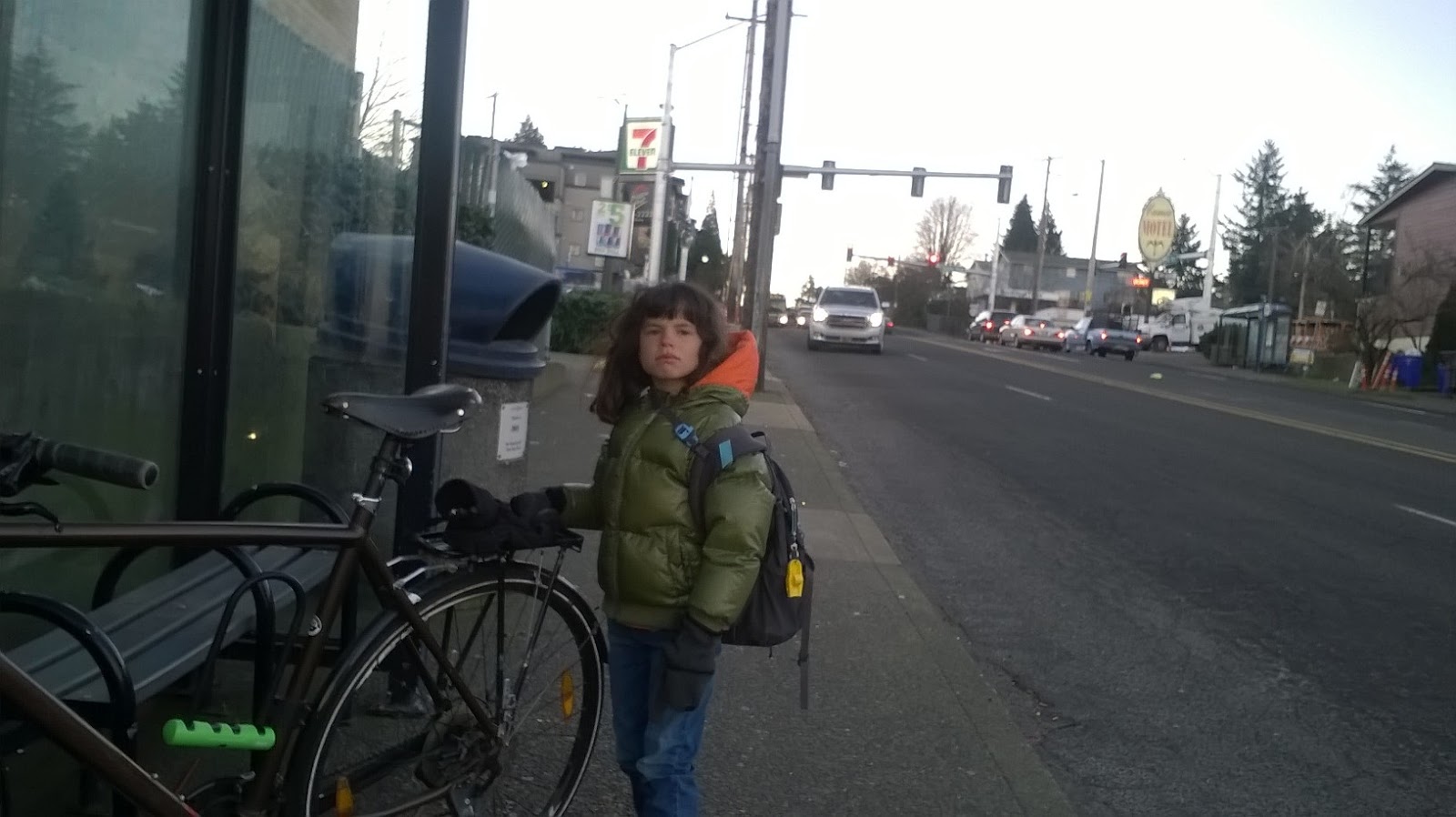
Sequoia may not look it, but in this week's cold weather, she's much happier to ride a warm bus than to ride a half hour on the back of a cargo bike.
Some unusually cold weather struck Portland as school opened up after the holidays, making the morning commute a bit of a trial.

Normally, I take our first grader, Sequoia, to school on a cargo bike. It's about a half-hour journey and in good weather it's a pleasant way to start the day. But the temperature on the first day of school this year was below freezing and the howling wind coming down the Columbia brought the "real feel" down to the mid-teens (about -10° C).

Sequoia was a trooper that first day on the bike, but the next morning, she was begging to go by bus. And with the temperatures dropping rather than rising, I could hardly say no. My selfish hesitation was that the school commute is the only exercise I get all day. But then I remembered that Portland's buses have bike racks, and that would allow me to take along my bike so I could cycle on the return trip home from Sequoia's school.

When the rack is not in use, it folds up and out of the way.

When you need to use it, you unlatch the rack at the top. It folds down,
you pop in your bike and then pull a spring-loaded, extendable arm over
your front tire to secure the bike. Easy when you get the hang of it.
In Budapest, city buses are not equipped with bike racks, and I was told this was because of a European regulation that forbids it for safety reasons. Despite this, bike racks are a common feature on American public buses, and Portland is no exception.

The racks on Trimet buses are mounted on the front and have capacity for two bikes. They're quick and easy to use, although the first time I tried it I couldn't figure it out and started panicking because I was holding up the bus. The driver came out and did it for me, and the lesson stuck -- precisely because it left a lasting scar on my delicate male ego.

One limitation with the racks, of course, is that they hold only two bikes. In times of high demand -- like in a torrential downpour that coincides with rush hour -- these racks quickly fill up so you can't count on Trimet to bail you out of a wet commute. I've also discovered that the racks are not big enough to accommodate my Kona Ute longtail cargo bike -- one reason I'm using a regular-sized bike this week.

But for this cold spell, the bike racks have been very handy and there have been no capacity problems (knock on wood). Until it warms up, the plan for our school commute is to bus one way and bike the other.

Friday, September 9, 2016

Goodbye BP, Hello PDX

Taking a page from Budapest, bike racks displace car parking on Portland's trendy NE Alberta Street.

Back to the US

This summer, our family made a big, long-debated move from Hungary back to the US, where both my wife and I are from. We all loved Budapest but for various reasons, we'd agreed some time ago that we would come back. The question was when and how, and to what city. For a few years, the issue hung up on such details.

But it has to be admitted that in the family discussions, I was the lone  foot dragger. The kids were eager to permanently relocate to the land of grandma and cousins and awesome vacations. My wife had been in Hungary even longer than I had, and she was ready for a change. I, on the other hand, had serious doubts whether we could do better than Budapest. We had good jobs; good day care and school; lots of friends and a great centrally-located flat in a gorgeous city (upstairs from the Bem Mozi with a view of the Duna). And importantly, everything was easy to access due to the compactness of Budapest and its superb public transport system. I lived in Budapest for 20 years and never owned a car. I loved not needing a car and the prospect of having to get one -- as most families do in the US -- was one of my biggest doubts about moving back.

But when Kristin was offered a job in Portland, Oregon, world-renowned as the American Mecca of transport cycling, that was it. I'd already given my qualified assent to a US move. Now the when, how and where were sorted out in undeniably excellent fashion. This was the time to jump.

Lance joined me for a last Budapest cycling demonstration in July -- in protest of Mayor Tarlos's unilateral rejection of the bike-friendly elements of the reconstruction of Bartók Béla út.
Kristin moved out ahead of us in May to begin work and scout out a home. The kids and I joined her here on July 13. I've been thinking of continuing with my blog, just changing the city of focus from Budapest to Portland. Originally, Cycling Solution was a fish-out-of-water concept: a look at Budapest cycling and transport through the eyes of an American. I think the idea still holds -- now in reverse. I spent so many years working and living in Europe that I practically went native -- at least with respect to my views on transport. So the blog is still a fish-out-of-water thing: cycling and transport in Portland through the eyes of a pseudo-European.

I wanted to get a feel for the place before writing about it, and now that we're going on two months, it's time to start. I've already been cycling a bit, and have spotted impressive infrastructure and other measures that promote everyday cycling (e.g. an innovative bike-share system, "neighborhood greenways", "buffered" bike lanes with wide safety zones on either side to separate cyclist from moving traffic and parked vehicles, and a cyclist-friendly wayfinding system). However, it's taken time to appreciate this. My first impressions of local cycling conditions weren't so good, which surprised me because the press on Portland cycling is generally super positive.

Biketown is the name of Portland's new public bike system. It just debuted in July.
On Portland's MAX light rail (akin to Budapest's HEV), you can take your bike at no extra charge (as opposed to the HEV, where you're charged double fare)
Neighborhood greenways are long stretches of secondary streets that prioritize cycling and discourage motorized through traffic. On a greenway, you can bike for kilometers on end without breaking stride while travelers on side streets are halted by stop signs topped with special bike emblems.

Great cycling city -- by American standards 

Although I have no doubt that Portland deserves its place among the top-rated cycling metros in the US (apparently 6% of work and school trips are by bike here -- higher than in any other large city in the country), Portland is still an American city. And not just American, but West Coast American, meaning it's much newer, more spread out and more car-centric than virtually any European city.

Portland has a small downtown core with taller buildings and apartment blocks, but most of the city rises just one floor, and the vast majority of residential development is single-family detached homes -- like the one we're living in now. We're about 6 miles (10 km) from the city center in a 100+ year-old neighborhood that looks quite a lot like neighborhoods a half mile from the center. There may be a duplex and multi-level apartment unit here and there, but most of it is detached homes with yards, driveways and garages.

This low density means that almost anything you want to get to requires a bit of a journey. For us, for example, the nearest grocery store is .7 miles (1.2 km); nearest park .6 miles (.9 km); and nearest post office 1.8 miles (3 km). We're by no means isolated -- in fact, because we're near a major thoroughfare (Sandy Boulevard), we have a bunch of nearby restaurants, bars and convenience stores (also pot shops -- marijuana being legal in Oregon). But it's not nearly as walkable as a normal urban neighborhood in Europe. On the other hand, it is bikeable. Our boy is biking to school, we bike for groceries and to get pizza and to go to judo and soccer practice. I bet with time, I'll find myself logging more distance by bike than I did in Budapest because all those trips I used to take by foot I now take by bike.

Longer trips are more of a challenge due to the comparatively scarce public transport. Again, we could do much worse than Portland. By West Coast standards, Portland is quite advanced in terms of public transport. Along with the bus system (which most cities in the US still have, at least in some vestigial form), Portland has a light rail network (connecting city to suburbs, like Budapest's HEV) as well as two streetcar lines (trams). The main public transport in our neighborhood are two bus lines along the nearest thoroughfares (buses 12 on Sandy Blvd and 72 on NE 82nd Street). The service on these lines is every 10-15 minutes during peak times and every 15-20 minutes during weekends and holidays. This service is categorised as "frequent" by the operator Trimet.

The sparse public transport in our neighborhood is another reason we're biking so much. Kristin bikes about 9 miles to work each way and I take our daughter to a school across town that's more than 5 miles away (two roundtrips a day). I believe in both cases, we save time over public transport. For trips where bikes don't work, we're relying on Uber. We've actually used Uber quite a lot, including some trips where we've hauled our bikes (for an extra fee, you can dial "Uber Pedal" and you get a car that can carry bicycles.)

Portland is certainly more of a car-driving city than Budapest. You hear about more and more people going carless, and the city has infrastructure and services that enable this if you're committed. But they'll need lots of development before car-free is the norm.

Friday, April 22, 2016

Cycling ban to be lifted on Szentendre Route 11

After years of being closed to cyclists, Route 11 in Szentendre will get advisory bike lanes.
It sounds as if the ban on cycling on Route 11 in Szentendre will finally be lifted. However, the timeline is murky and public authorities have made no public announcement on the matter.

Last week, a technical plan for the changes was presented in a closed-door meeting of stakeholders, including the Hungarian Cyclists' Club (MK).

As MK's staff engineer Miklós Radics explained in Facebook post, the ban will be lifted, but the road will be given only minimal cycling accommodations.

"They plan wide outside car lanes (at least 4.25m or more) with bike sharrows," Radics wrote.

Radics explained that the Szentendre section of Route 11 is not wide enough to accommodate the existing cars lanes and proper bike lanes. So the plan instead calls for sharrows, otherwise known as "advisory bike lanes", which motorists can drive on legally. An example of sharrows in Budapest are on Margit Bridge -- they're marked with chevrons and cycling pictograms rather than a solid line separating cyclists from motor traffic.

"It's not the best and most bike-friendly solution, but it's still a big step if we compare it with the nonsensical prohibition," Radics said.

"Moving the curbs and redesigning the whole road won't happen in the coming years. The municipality and the road maintenance company (Magyar Közút) will co-fund the budget for the repaint."

The plan was based on a study by the engineering consultancy Tandem Kft. on a commission by Szentendre City Hall.  Staff from Tandem revealed the study's results and recommendations last week to a group of select stakeholders, but neither City Hall or Magyar Közút have make any public announcement on the subject.

A representative from the Szentendre branch of the Hungarian Cyclists Club said they would prepare their own announcement on the scheme in the coming days.

Thursday, April 14, 2016

Mayor Kicks the Hornets' Nest

What was he thinking?
The April 23 cycling demonstration (formerly Critical Mass, now I Bike Budapest) is shaping up into a political showdown with Mayor István Tarlós.
Tarlós declared back in February that he believed cycling development in downtown had gone too far (while also claiming Budapest had become an "extremely public-transport oriented" city). In recent days, activists circulated an official document showing Tarlós's point-by-point plan of paring back pro-cycling measures. In it, the mayor declares he would:
  1. no longer prioritise the creation of bike routes that offer the shortest path from points A to B;
  2. no longer paint yellow bicycle pictograms on streets that also have separate sidewalk bike paths;
  3. revisit recently created bike contraflow lanes on one-way streets (about 120 such lanes in the city) and remove them except in exceptional circumstances;
  4. not allow bicycle traffic in bus lanes unless the lanes are at least 4.5 metres wide;
  5. on streets with bike lanes, prohibit cyclists from riding in bus lanes (undoubtedly, this applies to Bajcsy-Zsilinszky, although the bike accommodation there is technically a "bike path" not a lane)
Afterwards, Index.hu published a point-by-point response to the proposals, explaining how all of them have improved the bikeability of the city, and how Tarlós's proposals would reverse this progress. The Index article follows a more exhaustive set of recommendations concerning the next 10 years of cycling development from the Hungarian Cyclists Club. Both documents were written with care, with all propositions backed with evidence and reasoned arguments.

The mayor's response could not be described as reasonable. It was rather hysterical. The short communiqué signed by the mayor's communications director called the backlash to Tarlós's proposals:
"... a mysterious defamation campaign instigated by the tabloid press whose claims nearly violate the criminal code and border on slander."
The statement goes on to say that the mayor has "never called for the ending of cycling development" and that over the past  20 years, cycling development has never been as good as it has been during Tarlós's term.

And then it claims that "rational cycling development" is not the same as "the unrestrained terror of a minority of radical cyclists".

It seems to me that the one guilty of slander is Tarlós. The people he's calling a radical minority are the organisers and participants of the city's most popular civil movement since the founding of the democratic state. The Critical Mass ride (now re-branded as I Bike Budapest) has always drawn tens of thousands of participants -- in 2013 it drew an estimated 100,000. It's mainstream. The Hungarian Cyclists Club is a well-established NGO -- the biggest cycling lobbying group in the country, not a radical fringe group. And Index.hu, although obviously differing with the mayor politically, is one of the most visited news portals in Hungary.

Tarlós has really kicked a hornets' nest with this one. And his timing couldn't be better. Expect a big turned out for I Bike Budapest.

Wednesday, April 13, 2016

Pretext for removing bike-bus lanes?

The fast way to bike Bajcsy.
It looks like the mayor is getting set to close down Budapest's ground-breaking shared bus-bike lanes on Bajcsy-Zsilinszky ut. Mayor István Tarlós declared earlier this year that he didn't approve of the lanes -- or practically anything else that has to do with non-car urban transport. And in recent days, city road crews have been spotted conducting traffic counts of cyclists using the lanes, according to a post on the I Bike Budapest Facebook page. Looks like a pretext for shutting the lanes to bike traffic.

The bike-bus lanes were created in spring 2013 as an alternative to the narrow two-way bike lane on Bajcsy's west-side sidewalk. For various reasons, many cyclists prefer to ride on the street on Bajcsy, but because buses are prioritised on the Bajcsy's outside lanes, cyclists were not allowed to ride there.

By law, unless cyclists are given explicit permission to share a bus lane, they're supposed to ride in the second lane over, and not along the curb where slower traffic normally belongs. It was a contradiction in the traffic regime: In order to ride legally, cyclists had to ride between lanes of faster motor traffic. It's a dangerous place to be and shared bike-bus lanes were meant to correct the problem.

The mayor has said he doesn't like cyclists to be in bus lanes because it slows down bus traffic. Which is an odd justification for a mayor who otherwise seems opposed to buses -- or any form of transport other than a single-passenger occupied vehicle.

Bad times for sustainable transport in Budapest. But a good time to be an activist.


Friday, March 11, 2016

Cyclists Should Speak Up on Szentendre Route 11

Szentendre City Hall's surveying for a scapegoat.
Apparently, Szentendre City Hall is trying to derail a years-long lobbying effort to allow cycling on the Szentendre section of Route 11.

Last month, City Hall commissioned a "technical study" to see if the 6.5 kilometer stretch of Route 11 inside Szentendre could be opened to bike traffic. This follows several years of lobbying by a handful of cycling activists in Szentendre who are fed up with being banned from the city's main public road because of their environment-friendly choice of transport.

Cyclists who ride on Route 11 (myself included, full disclosure) routinely get pulled over and scolded by police and some have been fined. You can get a fine for even crossing the road by bike, which is crazy, because you need to cross Route 11 to get from the Budapest bike path on the west side of the road to the Szentendre bike path just opposite. You can make this passage through an unlit service tunnel, but it's inconvenient and especially useless if you're carrying baggage (as touristic cyclists on Eurovelo 6 do in summer).

When cyclists first lobbied on the issue years ago, City Hall deflected the question to another entity, the Hungarian Road Authority (Magyar Közút Nonprofit Zrt.). But under sustained pressure by the local branch of the Hungarian Cyclists Club, the City Council agreed to appeal to Magyar Kozut to see if the ban could be lifted. The road authority, although reluctant to make the change, eventually agreed it would defer to the city's wishes. The local cycling lobby was told that the cycling ban had been lifted, and now it was just a matter of putting up signage and painting lanes to seal the deal.

But this isn't what has happened. Instead, the matter's is being subjected to a technical study and it's once again unclear whether cyclists will get their way. In fact, from the sound of the latest official communication, the new study is City Hall's way of deflecting responsibility yet again:

"Many would like to be able to cycle on Route 11, but according to others, the already busy, often congested road is not suitable for safe bicycle travel," the announcement states. City Hall, therefore, "takes no stance on the matter."

What's worse, according to inside sources, is that City Hall is pressuring the engineering firm undertaking the study to dampen the expectations of cyclists. Somebody at City Hall has actually scolded the firm for making "optimistic statements" about the study. The firm was told not to make any public statements on the study at all.

As far as I can see, the city had hoped deflect the question onto outside experts in the hope it could be rejected on technical grounds. This would relieve officials from making a political decision.

It's a ruse. The only thing that makes cycling unsafe on Route 11 is fast-moving car traffic. Barring big investments in separated bike paths (which will not happen), the city would need to make some on-road bike lanes and to reduce the road's speed limit, say to 40 km/h. This is not a technical challenge, it's a political one: Does the City Council support it or not?

A small glimmer of hope is that there is an element of stakeholder consultation in the study: It's being carried out in cooperation with Magyar Közút; City Hall officials and the Szentendre branch of Hungarian Cyclists Club.

Now would be a very good time for cyclists to speak up on the issue, telling the mayor they support the Cycling Club and its efforts to allow bike traffic on the street. If you agree, please send a note, in Hungarian if possible but no necessarily, to the mayor at polgarmester@szentendre.hu.

Wednesday, February 17, 2016

Chrissie Hynde: Walker and Rocker


It's cool when your heroes do you proud. Often, the opposite happens (Lance Armstrong was a major disappointment), but over the past few years some of my favourite musicians from punk-rock days have turned out to be cool in ways I hadn't expected. For instance, my favourite bass player of all time, Mike Watt (Minutemen and fIREHOSE), became a born-again cyclist at age 37 after a 22-year hiatus of going by car only ("I  was an asshole!" he's quoted as saying). Then Talking Heads frontman David Byrne did Watt one better by becoming a spokesman for active transport and public space reform in New York City, and then writing a book about the joys of cycling. Recently, it's happened again: Chrissie Hynde, singer and rhythm guitarist for the (great) Pretenders, stunned and amazed me in a recent autobiography when she laid down some biting social commentary about the value of public transport and how her home country shot itself in the foot by killing it off.

Ok, "stunned and amazed" is exaggeration. Hynde has said some of this before. One of the Pretender's biggest hits, My City Was Gone, told of Hynde's dismay at what had become of her hometown, Akron, Ohio, in the wake of Autogeddon: the disappearance of the train station and of downtown, and the paving over of the surrounding countryside with shopping mall parking lots.

Her new book (actually published at the end of 2015) expands on these observations and shows that sustainable transport (not a term she uses -- but this is what she's taking about) is a huge preoccupation. In fact, after reading the book, it's a fair bet that sustainable transport (America's lack of it vs. Europe's wealth) is the main reason Hynde abandoned the States in her 20s, before she'd even made a name for herself, and then settled in London, where she hit the big time and still resides at age 65.

In an early chapter, Hynde describes the Akron of her childhood ('50s, early '60s),  as America's slide into car-centrism was under way. Hynde and a friend from junior high found themselves outcasts because they walked.
"Neither of us was interested in what the 'popular' kids were interested in ... . But what really set us apart, aside from our love of sewing, was that we were walkers. Our favorite pastime was walking to downtown Akron ... We walked, rambling and philosophizing; our journeys up West Market Street were adventures. We studied every house and redbrick road, speculating about their histories while discussing the world and what might be out there beyond Akron ... ."
One day, Hynde got on a bus for a covert excursion.
"Taking a bus almost felt like a subversive act, given that most (white) Americans living in the suburbs were required to have at least one car per family. Only 'poor people' got buses in the new world. Well, you couldn't walk to a bus stop out there -- it was too far. You'd have to get a lift to catch the bus, so why bother taking the bus if you were driving anyway?"
In her 20s, Hynde finally did get out of Ohio, and her peregrinations eventually led to London. She loved the Victorian buildings, cobbled streets and double decker buses. But the big revelation was the ease of getting around:
"Public transport! (What genius thought that one up? If the word got out in America, they'd all want it!) I could now go wherever I wanted, whenever I wanted. The days of waiting for someone to pick me up in a car were over. For the first time I felt like my own person; I didn't have to answer to anyone. It felt so right, like something I'd been waiting all my life for."
Of course, most of the book is about Hynde's music career, but I recommend it also for her social commentary on the differences between the US and Britain, including quite a bit about transport. For me, a fellow transport exile who loves the trams, buses and trains of Europe, this book showed a little of the heart behind Hynde's trademark snarl.

Thursday, February 4, 2016

Mayor dismantles Budapest Transport Centre

Yay, cars! (Image taken out of context -- shamelessly -- from http://444.hu/category/ikertornyok/)
It's taken more than a year, but Mayor István Tarlós last week finally managed to undo a key reform that had set Budapest on a course for a less car-centric, more sustainable city.

Tarlós sealed his anti-sustainability campaign by getting the City Assembly to dismantle the Budapest Transport Centre (BKK), the supra-administrative body set up in January 2011 so that city transport -- including roads, motor traffic, parking and public transport -- could be managed in a coherent, integrated way.

Tarlós criticised BKK for "overstepping its remit" and creating an "extremely public transport-oriented" environment. The mayor believes car drivers have suffered too much under BKK's stewardship, so he came up with a proposal that essentially restores transport management to what it was five years ago. According to the Assembly's decision, BKK will be stripped of its authority over roads and motor traffic, and will now look after just public transport and taxi regulation. It also keeps the task of strategic planning, while being in a much weaker position to implement plans.

Management of roads and traffic will be given to a separate administration, the Budapest Public Road Authority (Budapest Közút Zrt.).

Last week's vote was just the last smash up in a slow-motion car wreck that began November, 2014, when the City Assembly, at Tarlós's urging, voted to subsume BKK under a higher-level administrative body (Budapest City Management Center -- Budapesti Városüzemeltetési Központ) controlled by the mayor. A month later, Tarlos canned Dávid Vitézy, the 20-something wunderkind who headed BKK and tallied many victories for public transport. Tarlós publicly derided Vitézy because he didn't know how to drive, and also because Vitézy was achieving things too quickly. In an interview a year ago, Tarlós explained it wasn't that he didn't like Vitézy's changes, he just didn't like the speed of the changes. The mayor replaced Vitézy with a more agreeable and, presumably, slower manager, and with last week's restructuring, the BKK menace was buried. It takes effect in April.


BKK was a progressive umbrella transport agency modeled on successful global examples such as Transport for London and the Land Transport Authority of Singapore. With control of roads, BKK could effectively boost alternatives to the car by reprioritising road space and traffic management. For example, BKK created several priority bus/bike lanes in the downtown area and established new bicycle lanes and on-street bike parking. BKK could also give buses and trams traffic-signal prioritisation -- and we can already see in recent weeks how a lack of signal priority is undermining the potential of the new 19 tram line. In addition, BKK could enforce traffic rules to protect sustainable transport, for example by towing cars parked on bus stops, bike lanes or on Bubi public bike docking stations.

This gave the the city an efficient tool to make public transport faster, more reliable and, thus, more attractive to the traveling public. As Vitézy noted in a recent  response to Tarlos's move, revenues (from ticket and pass sales) for public transport grew by 20% during his four-year tenure at BKK, while fares stayed the same.

At first, BKK's castration might seem like a gift to motorists. But if it leads to a significant shift from public transport ridership and cycling to more car use -- and it's certain to do so -- traffic jams will get worse and everybody will suffer, including car users.

Lastly, this is sure to impair Budapest's ability to attract EU transport subsidies, because basic funding criteria favor projects that reduce congestion, save energy, improve air quality and combat climate change. Recent Budapest projects like the renovation of Margit Bridge, the new metro, the Fonodó tram project in Buda, and, of course, the Bubi bike share system, all received EU subsidies due to their positive environmental impacts. Tarlós's strategic direction completely contradicts these aims and just looks self-defeating.

Wednesday, January 13, 2016

Persistence pays

Potholes filled!
Posts about potholes don't make good click bait, but I had to note this development at my place of employment, the Regional Environmental Center in Szentendre.

For the past several years two big potholes have obstructed the entrance to the REC's parking area, and this was a big nuisance, even hazard, to the many staff members who commute by bike. This is especially true in winter, when sun sets before the work day's over . It was hard to see these holes in the dark and they were deep enough to throw you off your bike.

But this morning, with no advance notice, they were filled and smoothed over with asphalt.

Not sure how this miracle came to pass. But staff have complained about it for many years, and I have to credit my work mate and fellow bike commuter Jerome Simpson for leading the charge. You might be surprised how much time and effort it took to get two potholes filled. Jerome took this up long ago with REC management, who then informed him that this is actually a municipal issue because the City of Szentendre owns not only the street, but the REC's driveway and the whole front parking lot of our premises. So Jerome asked the REC to make an official petition to City Hall, and he also took it up with the REC's grounds manager. Leaving no stone unturned, when we got involved in a cycling promotion project with Szentendre City Hall, Jerome mentioned the potholes to the municipal staff who were represented. One of them, fortuitously enough, was the manager of city's equipment and infrastructure.

As I said, we don't know which straw broke the camel's back. But it may well have been the cumulative effect and repeated queries. Eventually, someone at City Hall must have gotten embarrassed.

The takeaway for cyclists, I think, is that this kind of direct lobbying does work -- eventually. Kudos to Jerome for sticking to it.

Friday, January 1, 2016

Budapest bike-movement leader dies

János was out on the night they marked the advisory lanes on the newly refurbished Margit Bridge.
This Sunday at 2 p.m., the cycling community will lead a memorial bike ride around Budapest to honour one of its most influential leaders, former president of the Hungarian Cyclists' Club János László.

János died December 23 of cancer. First diagnosed about a year and a half ago, he'd battled it to the end and continued his work with the cyclists' club (MK) until just more than a month ago. The club has posted a tribute to him on their homepage detailing his many contributions to not only cycling, but to the livability of Budapest and the development of civil society in Hungary.

János seemed to be everywhere where there was something going on in the cycling world, whether it be a demonstration, a conference, a meeting at City Hall or a bike fashion show. On the few occasions when I asked for his help on cycling matters, for instance taking part in a meeting to energize a nascent cycling movement in Szentendre, I was honoured that he immediately agreed to help -- and showed up in person to do it.

One of the last times I spoke to János, I asked him about prospects to create cycling lanes on Rákóczi út -- a proposal that activists have been pushing for probably 15 years or more. János shook his head and said, "It won't happen in my lifetime." János was so vital that I took this to mean it wouldn't happen for many, many years. Looking back, I guess he was probably intimating something about his illness.

János's work on cycling lasted barely a decade, but as anyone who's been here during that time can see, cycling in Budapest has developed by leaps and bounds over that time. Most people mark the start of the local cycling movement at the first Budapest Critical Mass in 2004, and János always acknowledged the importance of that moment. His own contribution was to give the movement a clear focus and course of action by establishing the cyclists' club as the country's leading lobbying group for cycling development.

Before János entered the picture, a couple cycling NGOs existed in Hungary, but they didn't really register on the political scene. They worked on an entirely volunteer basis and none of them had a proper office or staff. János took over MK in 2006 and scaled up its activities dramatically by getting a subsidy from Budapest City Hall and hiring staff, including people to run communications and campaigns and an engineer to look after technical issues such as infrastructure design and transport planning.

This enabled Critical Mass to achieve concrete progress beyond making cycling more fashionable. Under János's leadership, MK lobbied successfully for Budapest's first on-street cycle lanes on Alkotmány utca and the creation of the groundbreaking bike lanes on the Kiskörút (and the city's first automatic cyclist counter on the same street). Budapest got its first bike boxes (for instance, on Varsányi Irén utca) and its first "advisory" bike lanes (the chevron-marked lanes on Margit Bridge, ushered in with an MK-supported amendment to the national traffic code). János was also instrumental in the proliferation in downtown Budapest of contraflow bike lanes on one-way streets.

János is also credited for the inclusive way that he framed the cycling club's communications. He helped pacify some of the pugnacious tendencies of the cycling vanguard by insisting that the club wasn't simply for cyclists' rights, but rather for a more respectful and courteous relationship between all road users regardless of their mode of travel. The campaign of a few years ago featuring pictograms of a pedestrian, car driver and cyclist and the slogan "We travel together! (Együtt közlekedünk) was János's brainchild.

With his grey beard and long years of experience, János gave the movement a face of reason and seriousness. I think this gave extra heft to the club's lobbying efforts before decision makers, and it showed Budapesters that cycling as transport is not kid's stuff, but a choice for life.

It also gave inspiration to the movement's young foot soldiers. And this is probably János's greatest legacy -- the community of activists and experts who will pick up where he left off and strive to realise his vision for a more people-friendly city.

Saturday, December 12, 2015

Mayor outlines dismal vision of out-moded transport

Tarlos, left, is all about charisma and vision.
Budapest's conservative mayor, István Tarlós, gave the cycling movement a kick in the teeth yesterday, threatening to get rid of downtown's shared bike-bus lanes and consider compulsory operating licences for cyclists.

He also labeled as "dangerous" the recently introduced system of contraflow bike lanes, and promised to subject them to a review by a secret working group.

Further, Tarlós poured cold water on a marvellous conceptual plan, revealed just this week, that would create a pedestrian-friendly Pest embankment and establish two bike lanes on the Chain Bridge.

The mayor's proposals came during a transport-themed press conference Thursday, outlining, among other things, plans for future transport financing and the city's obligation to introduce congestion charging (no earlier than 2017, he promised).

The Hungarian Cyclists Club reacted in an open letter urging the City Assembly and the councils of Budapest's district governments to reject the proposals. If you'd like to express your personal disgust with these ideas, check the options at the bottom of the link.

The club's letter objected firstly to the closed process in which the proposals were developed. Tarlós said they came from a "working group" whose members weren't identified and who didn't consult with the cyclists club on its cycling provisions. Illiberal democracy in action!

Tarlós's ideas are based on his rejection of a basic principle of cycling development: that routes should be designed to give cyclists the shortest path between points A and B. This is the only way to make cycling practical and attractive as a means of transport. Tarlós complained that the city can't make this an "absolute priority".

Not that it ever has. The cycling movement has campaigned for many years to end the old-fashioned practice of creating circuitous bikeways that snake on sidewalks around hidden side streets. Long-standing campaigns to put bike lanes on the Nagykörút and on Rákóczi út are examples of trying to make cycling convenient and practical, and Tarlos's statement is a clear rejection of these proposals.

Paradoxically, Tarlós's anti-cycling agenda, and assurances of continued car-friendly transport, are wrapped in an overall concept that he calls an "extremely public transport oriented" system. He thinks cycling, the most space-efficient means of transport next to walking, is a main barrier to fast public transport.

This is why the shared bike-lanes need to be removed, he said. He provided no evidence that bikes are holding up buses, while ignoring the actual cause of slow bus service: traffic jams on streets that DON'T have priority transit lanes.

Tarlós called contraflow cycling lanes "dangerous", despite the fact that there have been no serious accidents on them. Contraflow lanes have been a success in cities the world over, not only making cycling more convenient, but actually enhancing safety because they allow for eye-to-eye contact between motorist and cyclist.

Tarlós also cited safety as a justification for operating licenses for cyclists, which he said could be implemented by 2018. He bases the idea, also unsupported, on his assertion that "eight out of ten cyclists run red lights." Tarlós declared: "Cycling culture is not developing at the same rate as cycling infrastructure."

In fact cycling culture has been developing and safety has been improving. Semi-annual observations organised by the movement have shown that more and more cyclists are using lamps after dark, for instance. And the overall incidence of serious road injuries and fatalities among cyclists has decreased in Budapest, in step with the increase in cyclist numbers. This improvement mirrors countless international examples: Promotion of cycling levels is the best way to improve cycling safety.

To cap off his dismal vision for a more retrograde city, Tarlós criticised the most exciting elements of a new development concept for the Pest embankment and Chain Bridge. The plan, focussed on the embankment between the Margit and Szabadság bridges, proposes a mix of motor-traffic reduction and elimination along different segments. Traffic on the Chain Bridge would be reduced to one lane for motor traffic heading toward Buda. The saved space would be given to bike lanes.

But Tarlós was clear in his opposition to the concept: "The city leadership does not plan for one-way traffic on the Chain Bridge or closing traffic on the lower Pest bank."

Wednesday, December 2, 2015

Week 4: Patch job accelerates ...

Path patch job is coming along, slowly but surely.
Three posts in a row about the Szentendre path patch job? That's obsessive. But whatever ... for the sake of documentation: The pace of the work has picked up. Maybe it had something to do with a colleague and I sending in impatient letters? Probably not. But the job has accelerated since then. At the beginning, the work crew came out just one day a week. But last week they came out two days, and this week they've come out three days already, and it's only Thursday!

Don't want to get too excited though.

My guesstimate is they've patched about 500 metres of path now. Let's hope for dry weather tomorrow.

Thursday, November 19, 2015

Job could take awhile

Szentendre bike path work moves progresses slowly.
As mentioned in my previous post, I went ahead an contacted the Hungarian Road Company, Magyar Közút Zrt., about their recently started patch job on the bike path between Budapest and Szentendre. In my email to them, I explained that the work to date didn't look adequate. The path is 25 years old and in a terrible state of repair. I told them I've been cycling on it almost daily since 2002, and that I've busted many spokes, wheels and axles because of all the cracks and potholes on this path. It needs a complete resurfacing, not the sort of remedial patch job that's being done.

I sent that note on Friday (Nov. 13) and received a reply on Monday from Attila Tóth, Magyar Közút's supervising engineer for operations and maintenance. In essence, he explained that the Szentendre bike path does not belong to the Hungarian road network, but due to an "unfortunate administrative procedure," Magyar Közút was selected to maintain it. The company tried to hand it over to local governments -- by which he means, I assume, the municipalities of Szententre, Budakalász and Békásmegyer -- but none of them manned up. Magyar Közút doesn't have dedicated resources for bike path maintenance, so they're expending only minimal energy on the current job, and only as weather allows. They're employing inefficient technologies ("by hand" he said), as their modern road-making machines can't access the path.

This response doesn't offer any solace or recourse to the users of the path. Just a long explanation of why the situation is shitty and why it can't be anything other than shitty.

On the bright side, I noticed this morning that a Magyar Közút road crew was on the job once again. As promised, the work is agonisingly slow. Last Thursday, they managed to fix about 100 metres of path and if they do the same today, that'll be 200 metres. At this rate (100 metres per week), we can expect the entire 10 kilometre path to be patched up in 100 weeks. But of course, work will cease during winter and when Magyar Közút is busy with more pressing work (i.e., anything else). So even if they stick with it, the job could take several years.

For those who use this path, I'd urge you to contact Mr. Tóth and tell him why this job is important:
Tóth Attila
Üzemeltetési és fenntartási vezető mérnök
Magyar Közút Nonprofit Zrt.
E-mail: toth.attila@pest.kozut.hu
Webpage: www.kozut.hu
For the record, here's my email exchange with Mr. Tóth in Hungarian:

Tisztelt Magyar Közút Nonprofit Zrt!

Ma reggel kerékpárral mentem dolgozni a 11-es út melletti kerékpárúton Budapest és Szentendre között, ahol észrevettem, hogy a Magyar Közút munkásai már elvégeztek néhány javítást az út egy rövid, 100 méteres szakaszán.

Az iránt szeretnék érdeklődni, hogy mik a Magyar Közút tervei a kerékpárút javításával kapcsolatban? Az útvonal 10 kilométer hosszú, 25 éves, és a teljes hosszában nagyon leromlott állapotban van - úgy gondolom, hogy a kátyúzás nem fogja megoldani a problémát, egy teljesen új burkolatra lenne szükség.

2002 óta járok Szentendrére dolgozni és szinte minden nap ezen az úton kerékpározok. A repedések és úthibák miatt számos küllő, kerék és tengely ment már tönkre az én és kollégáim kerékpárján. Bízom benne, hogy a Magyar Közút olyan megoldást talál, ami hosszú távon is lehetővé teszi, hogy az emberek végre kényelmesen és biztonságosan tudjanak kerékpározni Budapest és Szentendre között.

Válaszukat előre is köszönöm!

Üdvözlettel,

Greg Spencer
_____________
Tisztelt Greg Spencer Úr!

Köszönjük megkeresését a 11. sz. (Budapest – Esztergom – Tát) másodrendű főút 13+236 – 16+952 km szelvények közötti szakaszán az országos közúttal párhuzamosan haladó kerékpárút burkolat állapotára vonatkozóan.

Tájékoztatjuk, hogy a kerékpárút nem része az országos közúthálózatának, így Társaságunk részére nincs elkülönített, előirányzott forrás ilyen osztályú létesítmények kezelési és üzemeltetési feladatainak ellátására. Ezen túlmenően az országos közúthálózattal kapcsolatos feladatok elvégzése mellett korlátozott kapacitása és eszköze marad Társaságunknak ezen, rendezetlen tulajdonviszonyú kerékpárút üzemeltetésére, ill. karbantartására.

Tárgyi ügyben az évek során több megkeresés, illetve bejelentés érkezett már Társaságunkhoz. Álláspontunk továbbra is az, hogy a tulajdonosi háttér rendezetlen és Társaságunk csak egy szerencsétlen ügymenet kapcsán került üzemeltetőként kijelölésre.

Ezen rendezetlen állapot okán kértük az érintett önkormányzatokat, hogy vegyék át kezelésbe az érintett kerékpárutat. Természetesen az ingatlan-nyilvántartás rendezésében partnerek vagyunk és ehhez a szükséges segítséget Társaságunk megadja.

Mindezeket figyelembe véve területileg illetékes szentendrei mérnökségünk feladattervi lehetőségei alapján, a burkolathibák javítását - az erre megfelelő célgép hiányában, korlátozott technológia alkalmazásával kézi erővel tudja elvégezni, mivel a meglévő eszközeink számára a kerékpárút megközelíthetetlen – az időjárás és kapacitás függvényében folyamatosan végzi.

Kérjük tájékoztatásunk szíves elfogadását.

Üdvözlettel

Tóth Attila
Üzemeltetési és fenntartási vezető mérnök
Magyar Közút Nonprofit Zrt.
Pest Megyei Igazgatóság
1134 Budapest, Váci út 45 D.

Friday, November 13, 2015

Szententre bike path being ... patched :-(

These are some of the patches done November 12, 2015 at northern end of Szentendre Bike Path. Work to date covers about 100 meters of the 10 kilometre path.
Looks like I got carried away. From the looks of the ongoing work on the Szentendre bike path, it's not being resurfaced, as I was led to believe, but rather getting a remedial patch job.

Actually, it's not clear what's going on. Yesterday, there was a work crew on the path at the Szentendre end. They told me they were just getting started on a repair of the entire length of the path -- from Szentendre to Budapest. But checking the progress this morning, there were nine patches over a short section of maybe 150 meters, and the work crew was nowhere to be seen. I don't know if this means they'll be back later to continue the work, or if they've already called it good. But even in the best case, it looks like I got way ahead of myself thinking they were doing a resurfacing. It's a patch job, the latest of several that have been done over the years. I'm planning to send a letter to the authority in charge, Magyar Közút Zrt., to clarify their plans.

In the meantime, I documented a few representative cracks and potholes to show just how dire the situation is. Sections of the path are so disintegrated that they're basically being reclaimed by nature. Like in photos of the Chernobyl Exclusion Zone.
This section is about halfway between Budapest and Szentendre just north of the Renault dealership.
Here, the edge of the path has broken off and is gradually sliding into
the ditch along Route 11.
Several years ago, some pavement milling was performed to smooth out some of the more egregious heaves and buckles on the path. Normally, milling is followed by resurfacing, but in this instance, they milled a few spots and disappeared. The result was awful. In some spots, the path had become even worse. Which is saying something.
This is a fun one for the adventurous cyclist. The recommended line of approach here is on the right, about 20 cm from the edge. You can't avoid a bump, but you can cut your losses. 
Mars Rover view of volcanic perturbations.
Hoping the patch crew won't overlook this one.

As bad as this looks, the experience of riding on it is even worse.


Thursday, November 12, 2015

Szentendre bike path being resurfaced

Men at work -- hopefully.
 I still can't believe it. This morning on my commute from Budapest, I came across a road crew on the bike path in front of the Szentendre Aldi. They said they were just starting work on a complete resurfacing of the path. All 10 kilometers from Szentendre to the northern border of Budapest.

This path -- running along the west shoulder of Route 11 -- is about a quarter century old, one of the oldest existing paths in the Budapest area. It got a crappy patch job five years ago, but has never been resurfaced. I chronicled by hate-hate relationship with it here: its ruts and holes and gaping cracks have busted many spokes and wheels and axles. If I was Wierd Al Jankovic, I'd write an adaptation of Johnny Cash's "San Quentin". The first line: "Szentendre Bike Path, I hate every inch of YOU!!"

But nevermind, a three-guy road crew from Magyar Közút Zrt. was working on a small section of the path near Aldi, and they claimed to be doing a complete resurfacing of the path from start to finish. I think they said it'd be finished in a month's time. I'll keep posting on the progress.

Thursday, October 8, 2015

Car-free Chain Bridge!!

The way it outta be. Image stolen from here.
If you're for a calmer, quieter less congested city centre, you should come join a demonstration this Sunday afternoon for a car-free Chain Bridge.

The Chain Bridge will soon be renovated, and the Hungarian Cyclists Club sees this as an opportunity to restore its original purpose as a quick, convenient link between central Pest and the Buda Castle.

In its current state, the Chain Bridge is clogged with traffic jams for large parts of every weekday, and on busy weekends, as well. This is because most of the daily users -- 57 percent, according to a city study -- cross by car, the least space-efficient mode of transport, with an average of just 1.2 passengers per vehicle. Meanwhile, 37 percent go by bus (capacity around 80), but they don't get any reward for making a more space-efficient, environmentally friendly choice. They're stuck in the same, creeping traffic jams as the cars.

Bicyclists comprise about 6 percent of daily bridge traffic. And although the bike may be the fastest way to cross the Chain Bridge, it's not a pleasant way to go because you're either squeezed between cars and the bridge railing, or you're maneuvering amongst pedestrians on the sidewalks, where many regard you as a nuisance.

If the bridge was wider, buses could have priority lanes, but it isn't. A common-sense solution is to kick out the cars, and give it back to people. In this way it could be more like the Charles Bridge in Prague -- part and parcel with its eye-catching, historic surroundings, and free of noise and traffic fumes from cars.

The Cyclists Club proposes to start next summer, after school's out, by conducting a temporary trial in which buses would be given top priority in traffic. Without car congestion, bus departures could be more frequent, and the service would be much faster and more reliable. Top speed on the bridge would be held at 30 kph in order that cyclists can share the roadway safely and harmoniously. And pedestrians will have the sidewalks to themselves -- as they should. Last but not least, the Chain Bridge will once again be a feasible route for emergency vehicles.

Many will wonder where all the car drivers will go. But as with the pedestrianisation of Vaci utca and Raday utca, or the traffic reductions on the north-south axis from Ferenciek tere to Szabadsag ter -- people will find alternatives. Either a different route or a different vehicle choice.

If you support this vision, you can sign the Cyclists Club's online petition here. If you'd like to join a cycling demonstration, here are the coordinates:
When: Sunday, October 11. Gathering starts at 2:30 p.m., parade departs at 3 p.m.
Where: Széchenyi tér in the parking area in front of the Hungarian Academy of Science (MTA)
Parade route: Széchényi tér - Chain Bridge - tunnel - U-turn at Attila út - tunnel - Chain Bridge - Széchényi tér. Repeat route once, then return to Hungarian Academy of Science.

Demonstration announcement in Hungarian.

After the demonstration, there will be a public forum on the topic.

Tuesday, October 6, 2015

Bringing Bike Sharing to the 'Burbs?

Peter Dalos, operations manager of the Bubi system, presents at a spring, 2015 public hearing on bike-sharing in Szentendre.
At the Regional Environmental Center, we've just completed a feasibility study on bringing bike-sharing to Szentendre. The result: there's strong popular support for a scheme, and the optimal option would be an e-bike, or pedelec, system with 11 docking points scattered about town.

The nitty gritty of the study, funded by the CIVITAS Initiative, is summed up here.

But I also had some thoughts about it. On the positive side, we had outstanding involvement from City Hall: four or five staff members (including finance, infrastructure and communications experts) attended all of our meetings, and one event was attended by Szentendre's mayor. We also had the involvement of BKK, because one of our original ideas was that Szentendre's system could be an extension of the Bubi system in Budapest. It was one of eight alternatives that we explored.

As you can see in the study, the public was very supportive, with 76.1 percent of survey respondents fully or strongly in favour of introducing bike-sharing in Szentendre, and nearly half saying they would use the service at least occasionally.

Szentendre residents at the spring, 2015 public hearing raised several questions about the proposed scheme.
Despite the positives, it's an open question whether City Hall will take the next step and invest in bike sharing. One thing we learned during the study is that Szentendre, despite its beautiful historic centre and prime location on the riverbank just north of the capital city, is quite cash poor. Cities in Hungary rely on an industrial tax for most of their revenue and Szentendre is more of a residential, bedroom community than a place for business (the wealth of ice-cream shops notwithstanding). So there's considerable reluctance to make investments in anything viewed as non-essential.

There are ways to solve this. There are funding programmes that could help with the investment and there are opportunities for corporate sponsorship which could cover at least part of the operational costs. We even learned of a potential scheme organised by a passenger boat service that would implement bike sharing in riverside communities as a service for their customers.

Beyond that, there's the possibility to go with a low-tech, less expensive version of bike sharing. Although an e-bike system with automated docking stations is attractive, especially given Szentendre's hilly surroundings, the city could implement bike-sharing with standard bikes that could be rented out from a space at the city's HEV stop. The investment would be quite small -- just the bikes, a chip-card reader and a rudimentary shop. You would need staff to run it, as well. But this would be a very handy service for tourists coming up to the city by HEV or Volan bus, and in time it could be expanded and adapted to the needs of commuters (the Dutch OV-fiets system, run by the national rail company, is a good model).

In any case, we've handed the study over to City Hall, and the ball's in their court. There's evident will at City Hall to make Szentendre more bike and pedestrian friendly. It took some tentative steps in that direction this summer, and in our study we've argued that bike-sharing is a powerful tool to promote cycling -- not just on shared bikes, but on any bikes. We're hoping City Hall takes heart.

Thursday, July 2, 2015

Bike Sharing Boosts Property Value

As reported by several outlets (including here and here) the Bubi bike share system has recently been expanded  by 22 new docking stations, bringing the total number of locations to more than 90.

Most of this  expansion was thanks to a contract penalty that BKK enforced against the technical supplier led by ICT company T-Systems Hungary: Due to the delayed rollout of Bubi in spring of last year, the T-Systems consortia had to compensate BKK with HUF 180 million (EUR 589,000).  Rather than paying cash, the providers agreed with BKK to add the new docking stations instead.

But that doesn't account for 100 percent of the expansion. One of the new stations, specifically the one at Corvin Sétány housing and shopping development, was financed by the property's owner. As such, it becomes the first Bubi docking station to be paid for with private money.

This represents a new possibility for system expansion, and a new opportunity for business people interested in the cyclist market. Bubi will install a docking station on your property for a fee, and will take care of its operation and maintenance thereafter. A large station such as the one at Corvin Sétány, with spaces for 30 bikes, along with a rental terminal capable of selling tickets with a chip card reader, is yours for HUF 6.83 million (EUR 21,700). After signing on the dotted line,  the station will be installed in seven to eight months.

Why would someone shell out for such a price? According to János Berki, who headed the Corvin Corvin Sétány project for Futureal, a key consideration for the whole Corvin project was sustainability, with an accent on people and livability. This naturally included cycling facilities, including ample bike racks and changing rooms and showers for office spaces.

Berki didn't mention the docking station's impact on property value, but this may well have been an ulterior motive. According to new research, proximity to public bike sharing stations postively impacts on residential property value. The study, focusing on Montreal, Quebec, showed that for every single bike-share station located in a neighborhood,
"... $700 in property value is added to surrounding houses. Considering that, in Montreal, homes in a bike-sharing friendly neighborhood are, on average, within range of just over 12 stations, the value grows by almost $9,000; that's a 2.7 percent increase in sale value solely by virtue of living near a bike-sharing system."
This makes sense to me. Public bikes not only make a neighbourhood more accessible to more people, they contribute to its appeal as a fashionable, modern quarter.

Meanwhile in Dopeville ... the blog kerekagy recently reported on a "Facebook protest" among regulars of the Matyas Pince, a restaurant at Marcius 5 ter that specialises in traditional Hungarian fare. A Bubi docking station was placed in front of the eatery's entrance, provoking complaints about how it detracted from the historic elegance of the place. Realising that the Matyas Pince menu would of course be heavy on pork, this is very much a case of pearls before swine.